Tuesday, July 7, 2015

How to Use Social Proof to get Better Results from Facebook Ads

Today’s article is a guest contribution by Aimee Millwood.

Facebook ads provide enormous potential to grow traffic and sales. But knowing how to create ads that get results isn’t easy. Many businesses fail to grow traffic on social because they don’t know how to create ads that grab attention.

Here’s the bottom line: To sell on social media, you must use social proof, and it has to be the right social proof.

Don’t just take our word for it.

What the Data Has to Say about User-Generated Content (UGC) Facebook Ads

We ran A/B tests to compare how Facebook ads with customer content performed against ads with only brand content.

We saw that cost per acquisition dropped significantly, while conversion rate and average order value shot up.

On average, Facebook ads with UGC had:

  • 300% higher click-through rate (CTR)
  • 50% lower cost per click (CPC)
  • 50% lower cost per acquisition (CPA)

Why the great results?

For one thing, selling on social has traditionally been difficult for many brands. Social is a place where people go to connect with their friends and networks, not to look for things to buy. As Gilt’s Susan Lyne put it, trying to sell on social is like trying to sell at a bar.

She may have a point, but done correctly, selling on social is possible. You’ve just got to join in the conversation rather than interrupt it.

By integrating content created by customers (and Facebook friends), people see a recommendation from a person they trust, not an ad thrown at them by a brand.

These results are great, but they don’t mean you should run off to Facebook and start putting your customers’ UGC on ads.

It’s not enough to simply plaster a customer-submitted Instagram photo or product review on an ad. You need to know how to integrate customer content intelligently in order to tap into its potential.

How to Get the Best Results from Facebook Ads

We’re here to teach you what the data showed us about how to drive the best results from Facebook ads.

We sat down with our Director of Advertising and took a look at insights gained from testing thousands of customer-content Facebook ads. Here are our conclusions along with insider tips on how to get the best results from Facebook ads.

These tips and statistics deal specifically with using reviews in Facebook ads, but the advice applies regardless of what type of UGC you’re using.

1. Take Advantage of Ad Copy

The review (or other UGC) is obviously the most important part of the effectiveness of the ad. But the ad copy is a key element as well. Some tips:

  • Keep it short. Shorter ad copy performs better.
  • Though it may seem counter-intuitive, don’t use the word “reviews”! It comes across as too salesy. Ads with the word “reviews” in the copy don’t perform as well.
  • Make sure the voice in the copy matches your brand voice and message, not the customer’s. The review is where you let the customer speak. The top of the ad should stay on brand.

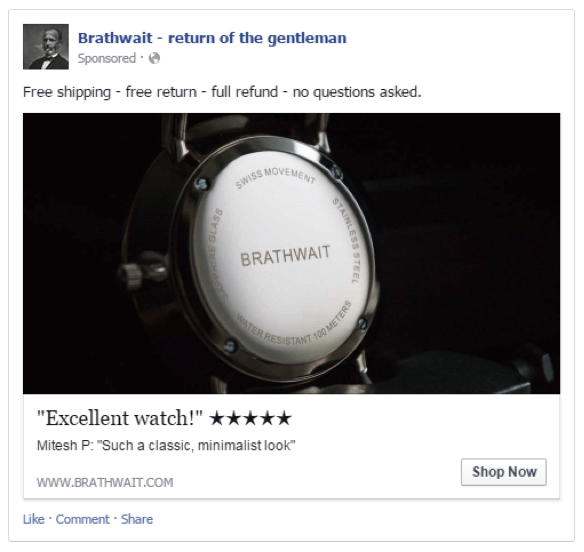
For example, in the ad below, notice how the ad copy is short and to the point, in the same tone as the review itself. Also, the copy is concise but comprehensive, making it easy for people to understand the message instantly.
brathwait-return-of-the-gentleman

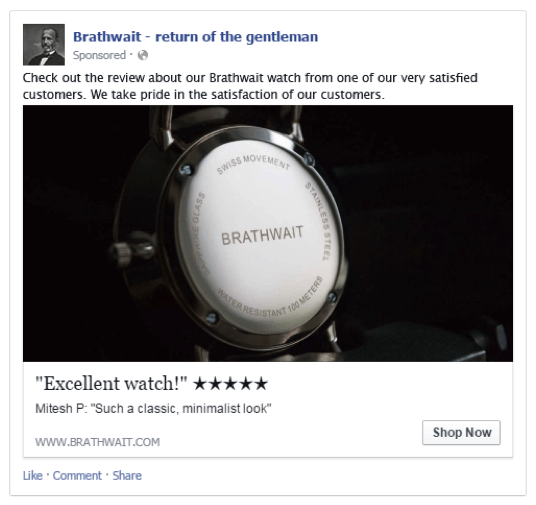
However, the following ad copy refers to the review; and because of this, it comes across as too salesy and forced. Additionally, the tone is much more formal than the review, so it doesn’t work as well. Also, it’s too long, so it doesn’t have the same impact that short, snappy ad copy does.
brathwait-return-of-the-gentleman-2

2. Use Product Reviews for First-Time Visitors and Site Reviews for Re-targeting

In social advertising, it’s vital to target the right person with the right message at the right time.

When it comes to Facebook ads, this means you should use a specific kind of review, depending on whether people are familiar with your store or they are first-time visitors. When you’re trying to gain clicks and traffic, it’s better to use product reviews.

Use reviews of top-rated, top-selling products to attract first-time visitors with specific items.

nations-photo-lab

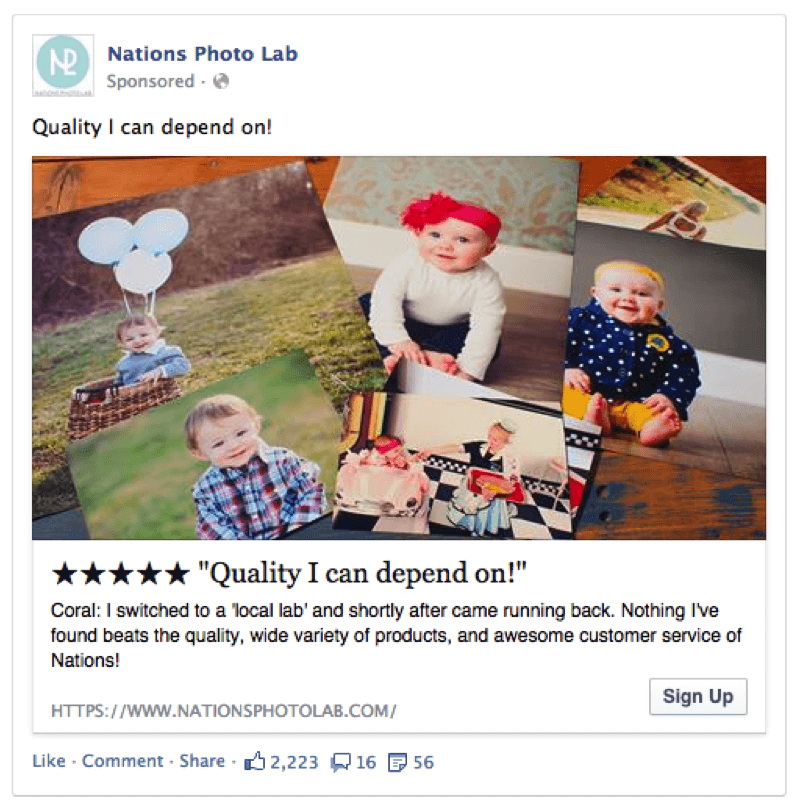
Once someone has clicked through to your site, seal the deal by re-targeting them with ads containing site reviews.
nations-photo-lab-2

Why? Top-rated, top-selling products will attract new visitors, but after they visit the site and don’t buy the product, it’s more effective to re-target them with site reviews. Site reviews emphasize the authenticity and strength of the brand, not a specific product, so the reviews will reinforce your brand even if the visitors don’t want to buy the specific product.

3. Include Personal Key Words

You might be proud of a review that says “Great shipping and excellent service,” but that doesn’t mean it makes good copy for an ad. Especially on social media, people want to read about real experiences. Using personal pronouns is a psychological cue that the stories are authentic.

Because of this, reviews that have words like “I,” “my,” or “we” are much more effective than reviews that don’t refer to personal experiences.

4. Avoid Reviews with Multiple Exclamation Points

The beauty of using UGC as ad creative is that it is genuine and credible content from real people.

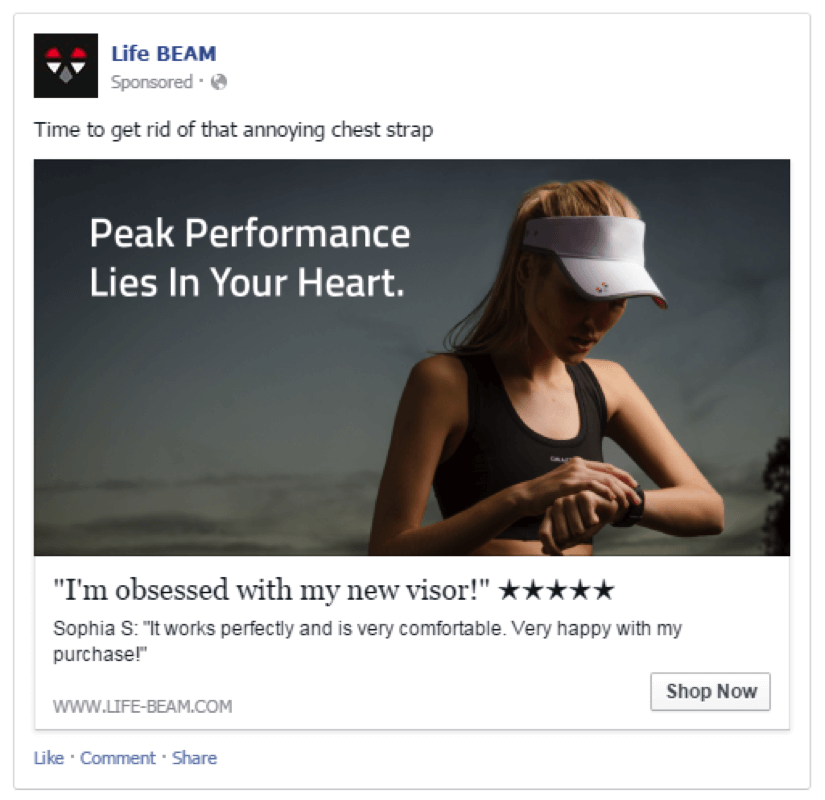
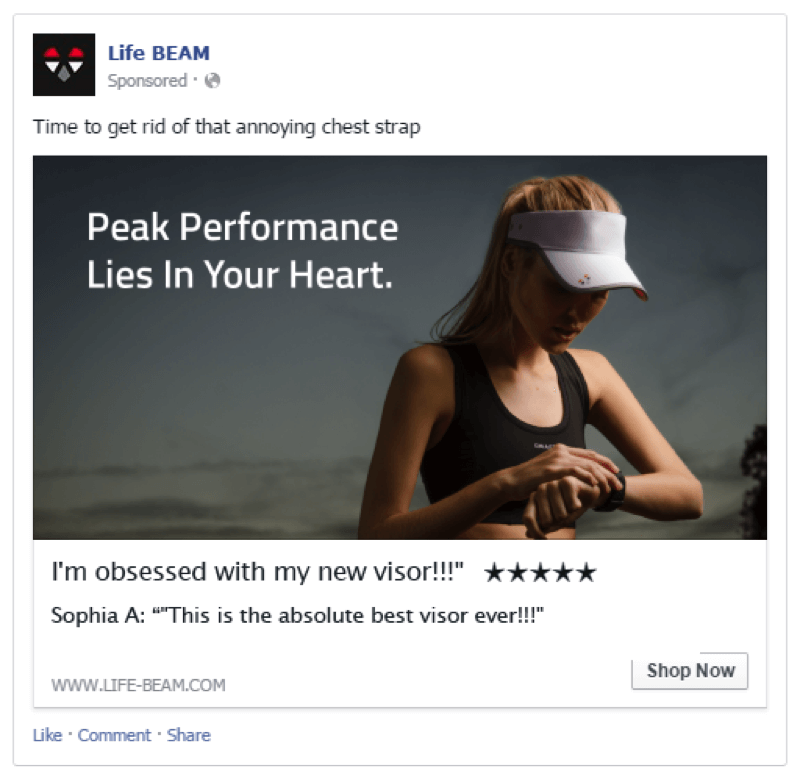
However, when the copy is too enthusiastic, even if it is real, it looks fake to the reader.

Even though the overexcited review looks good to you, it is less trustworthy, which is why ads using reviews with “!!!” are less effective.

So, keep your reviews to one exclamation point maximum.

Look at the difference in the two ads below. While subtle, including too much enthusiasm doesn’t seem as trustworthy.
life-beam

life-beam-2

5. Focus on the Experience

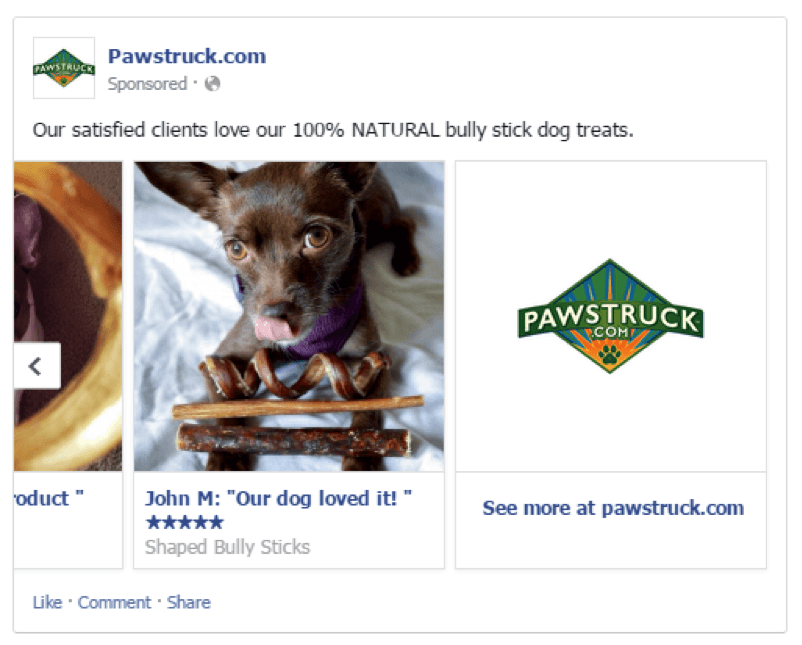
It’s better to use a review in which someone talks about using the product than one in which they describe the fast shipping. Once again, it comes back to people wanting to relate to a real and personal experience.

Reviews that tell a story like “I gave these bracelets to my daughter for her birthday and she was so excited,” are more effective than something like, “The bracelets arrived quickly.”

In the example below, the carousel displays reviews with generic praise about the product and service.

pawstruck

In contrast, the following carousel contains specific examples of personal experiences, making it much more effective and relatable.
pawstruck-2

6. Test It First

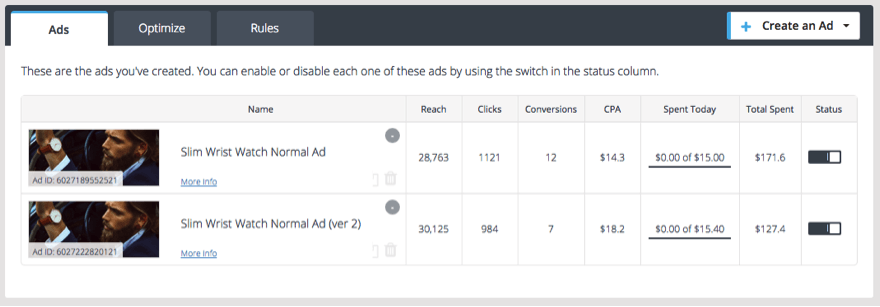
Try not to put money into anything you haven’t tested organically first. The beauty of Facebook is that you have a lab where you can test content, albeit on a smaller scale than with an ad.

Test different copy, images, and audiences to see what resonates before you pull out your money.
test-it-first

In summary, the customer’s voice is your most powerful marketing tool. Use it to your advantage by integrating customer content in your Facebook ads. These tips can help you get the best results from this effective strategy.

About the Author: Aimee Millwood (@aimeemillwood) manages the Yotpo blog, where she writes about marketing, growth, and engagement.

Monday, July 6, 2015

5 Essential Ways Marketing Must Change to Support Inside Sales

After years of running and advising startups, I’ve found that many businesses struggle with friction between sales and marketing. Sales often complains that marketing is not generating quality leads. Marketing, on the other hand, criticizes sales for not properly following up with prospects.

In the few companies I was involved with where marketing and sales were aligned, the difference was palpable. These businesses had a clear go-to-market strategy that translated into well-defined priorities for every employee. They also had a much stronger company culture and terrific morale across the organization.

On paper, aligning sales and marketing shouldn’t be hard. Marketing, after all, has the same goal as sales (or, as Peter Drucker said, “the aim of marketing is to make selling superfluous”). In practice, however, finding a good fit between the two departments is one of the more difficult problems in business.

This problem is all the harder in the age of inside sales. With shorter sales cycles and lower price points, there is very little opportunity for sales and marketing to collaborate on specific deals. Throw in the typical strong personalities of sales and marketing leaders, and you have an interesting challenge.

Solving the sales-marketing alignment challenge is critical to your business success. For inside sales to work well with marketing, it is imperative that marketing adopt a few key changes to its principles and processes.

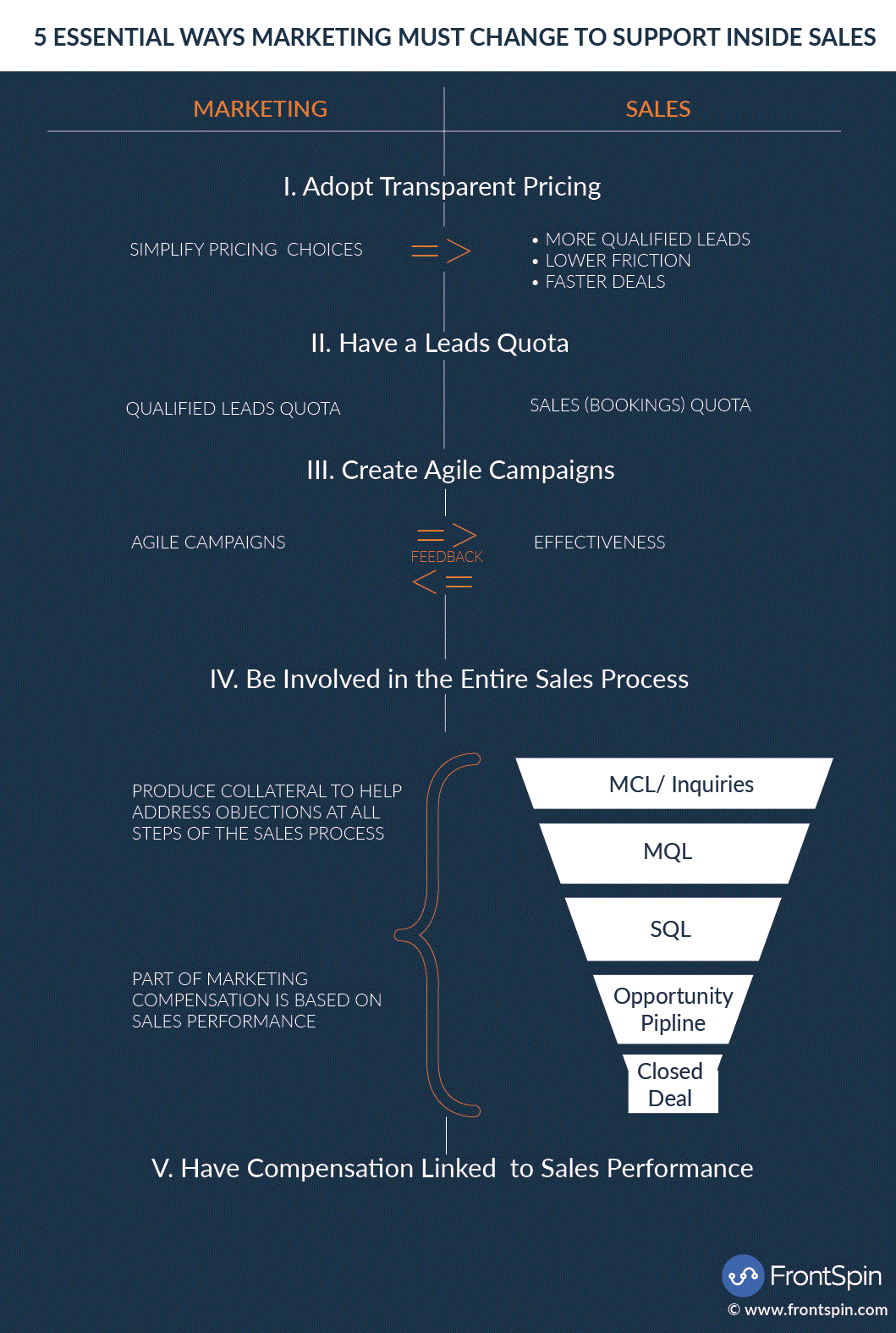
Here are 5 ways marketing must change in order to become effective in a high velocity inside sales go-to-market strategy:

1. Marketing Must Adopt Transparent Pricing

Selling software used to involve sitting across from a prospect, showing off a product demo, and then offering a custom quote based on the customer’s requirements and input from the sales manager.

This method does not work in the present-day context. Buyers today have access to much more information, and they complete nearly 60% of the sales cycle before even talking to a rep. They demand transparent pricing in order to purchase only the products that fit within their budgets and feature requirements.

Besides being more buyer-friendly, transparent pricing offers two tacit benefits to your sales team as well:

  • More qualified leads: Transparent pricing helps buyers qualify your solution for their budgets and reach out only if there is a fit. By pre-qualifying buyers this way, you can ensure that only higher quality leads get through to your inside sales team.
  • Lower friction, faster deals: At an average of 45 days, inside sales cycles are significantly shorter than field sales. To sustain shorter cycles, you want prospects to make purchase decisions quickly. Transparent pricing ensures that your sales team spends the least amount of time possible on pricing. They can focus on the more valuable task of sharing the benefits of your solution for a specific prospect’s needs.

Ideally, you want your pricing to be as easy to understand as possible. You can vary pricing by features or users, but make sure to optimize for, at most, two variables. More than that and you will confuse prospects and lengthen the sales cycle.

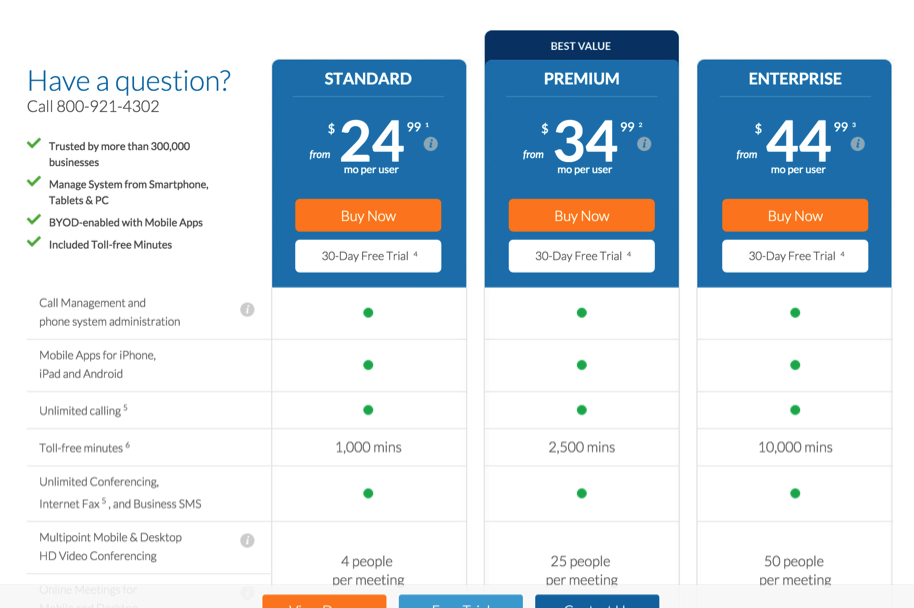
RingCentral is a great example of transparent pricing. It offers pricing based on number of users and edition (bundle) chosen. With just three different plans, prospects don’t have to struggle with choosing from endless plans and customization options. This removes friction from the sales cycle and helps RingCentral sell more.

pricing-page-6-6-15

Contrast this with their competitor ShoreTel. Although ShoreTel offers similar products, its pricing plans are confusing and non-transparent. Buyers who land on the ShoreTel website have no option but to contact a sales rep, even if the products are beyond their budget or requirements.

shoretel-pic

Key Takeaway

More options work well with enterprise sales where your goal is to maximize revenue per deal, but in a high velocity inside sales environment, limiting choice yields better results (600% better, according to one study). By directing marketing to adopt transparent pricing, you will ease the buyer’s decision-making process, thus aiding the inside sales team.

2. Marketing Must Have a Leads Quota

The performance of a sales team is a function of the total number of leads it receives each month. The higher this number, the more leads it can process, and the more it can sell.

This is true for every sales team, but is all the more pertinent for inside sales. The inside sales cycle is much shorter than field sales (around 45 days versus 6 to 9 months for field sales), and inside sales reps are not bound by physical limitations (such as taking meetings), which enables them to handle much higher lead volumes.

Thus, a high velocity inside sales team needs a constant influx of qualified leads delivered at a regular rhythm to be successful. This is the reason marketing must have a monthly leads quota. If marketing can’t send enough leads to sales even for a single month, it will be difficult for the inside sales team to meet its bookings number. This is bad for the bottom line and worse for sales-marketing alignment and morale.

Jason Lemkin of Saastr.com agrees, saying that just as a vice president of sales carries a sales quota, a “vice president of marketing needs a leads quota.”

For this idea to be successful, however, sales and marketing must work together to define what makes a qualified lead. In the past, it was common to use BANT (Budget, Authority, Need, and Timeframe) as qualifying criteria, though today more relaxed criteria is used. Once sales and marketing agree on a definition of a qualified lead, marketing can be held responsible for a monthly qualified leads quota.

Key Takeaway

Give your marketing team a leads quota with well-defined qualification metrics. This is necessary for the success of your inside sales team.

3. Marketing Must Run Campaigns That Are Flexible

Prior to inside sales, it was typical to have long lead-time marketing campaigns and not get the results of their effectiveness until months later. So, marketing heads would draw up year-long marketing plans in November, and then wait until March-April to see whether the initial campaigns worked (or not). You had little access to data, and whatever little data you did get often took months to roll in.

Compare this with marketing campaigns today, and you will see two significant changes:

  • Marketing campaigns generate more data: You can launch a brand new marketing campaign, buy some PPC traffic to test your messaging, and get tons of actionable data within hours. If the data passes your benchmarks, you can then go ahead and launch it at scale, passing the leads to your inside sales team.
  • Inside sales teams generate results faster: Once the leads start rolling in, a competent inside sales team can close them within days. Thanks to these shorter inside sales cycles, your marketing team can get constant feedback on the campaign’s effectiveness.

In this scenario, the only way to succeed is by running agile campaigns that can accommodate feedback from inside sales. Your inside sales reps should be in constant touch with marketing, telling them exactly what works and what doesn’t. Marketing, in turn, should use this data to optimize the campaigns constantly for best results.

Key Takeaway

Make sure your marketing campaigns are flexible and adapt as per feedback from inside sales. If something doesn’t work, marketing should move quickly to change course. If something does work, marketing should increase spending on it.

4. Marketing Must Be Involved in the Entire Sales Process

It is inevitable that your prospects will raise objections in the course of the sales process. How effectively your reps can answer these questions will be instrumental in determining your win rate.

Traditionally, the responsibility for addressing objections falls upon sales reps. In my experience, however, you see a lot more success by offloading this duty to marketing and involving marketing in the entire sales process. This will also save your sales reps’ time since a majority of reps spend up to 30 hours a month producing sales material.

As an example, in my last company, our customers in the healthcare industry would go through the entire buyer’s journey, but raise objections about HIPPA compliance (required by government regulation) before making a purchase decision. Of course, our reps would answer their queries, but it was usually haphazard and dependent on the individual rep.

To meet these challenges, I directed our marketing department to collaborate closely with inside sales and gather a list of common customer objections. Marketing then went to work creating detailed material for each query and distributing it across the team. Any time a rep encountered an objection, he or she could use this informational material to move customers further along the sales cycle.

Thus, whenever our healthcare customers raised objections, they received a detailed whitepaper on HIPPA compliance. Since this document was common throughout the sales team, we could also answer customer queries in a consistent manner.

The results were telling. Our win rates increased dramatically, and we quickly became the leading SaaS Contact Center Solution for the healthcare industry.

Key Takeaway

Marketing can no longer just hand over leads to sales. It has to be involved in the entire sales process, producing informational material and helping sales reps address prospects’ objections in order to nudge them down the sales process. A professionally produced marketing document will work much better than a quickly drafted email from a sales rep in answering prospects’ questions.

5-Essential-Ways-Marketing-Must-Change-To-Support-Inside-Sales

5. Marketing Compensation Must Be Linked to Sales Performance

We’ve already discussed how marketing has to carry a leads quota. In addition, for true sales-marketing alignment, marketing’s variable compensation should be based on the inside sales plan achievement.

There are two very good reasons for this:

  • Marketing gets compensated based on its role: Once marketing is involved in the entire sales process and carrying a leads quota, a part of its compensation should be linked to its role in the sales cycle.
  • Marketing works better with sales: Sales often feels that marketing gets compensated even when sales does all the heavy lifting (i.e., making the actual sale). By linking marketing compensation to sales achievement, you will ensure that marketing is more involved than ever in helping sales achieve its goal.

Key Takeaway

Once marketing is more involved in the sales process, part of its variable compensation should be linked to sales performance (around 25%). This can also help in better sales and marketing alignment.

Conclusion

Over the last decade, inside sales has been a transformative force in sales organizations, especially in B2B sales. It has changed not only the way we sell, but also the way we market our products. The inside sales go-to-market model is here to stay and is only gaining momentum.

For inside sales to be successful, it is imperative that marketing adopt a few fundamental changes. This includes bringing more transparency to pricing, linking marketing compensation to sales performance, and involving marketing in the entire sales process.

These changes may be hard, but they are critical for modern business. They will help you sell more, run better sales teams, and most importantly, create the all-important sales-marketing fit necessary for business success.

About the Author: Mansour Salame is the Founder and CEO of FrontSpin (an inside sales SaaS provider). He is a hi-tech entrepreneur with multiple successful exits. He enjoys building high performing teams and is passionate about inside sales.

Friday, July 3, 2015

How Fiverr Conquered Conversion with 400 A/B Tests and Counting

Meet madmoo. She lives in the United Kingdom. She will find a unique way of visually presenting your copy, be it with coffee, rocks, blocks, magnets or even alphabet-shaped pasta.

madmoo
Just a few of the creative typography options offered by madmoo.

In a lesser world, finding someone to execute such a niche project could be a herculean task. Thankfully, we do not live in a lesser world. We live in a greater world, where you can hire madmoo — along with thousands of other freelancers specializing in any discipline you can imagine — for just $5.

It’s all thanks to Fiverr, a marketplace that connects freelancers with clients in an ingenious way.

And they’ve optimized their inbound marketing with the same kind of ingenuity: in less than a year, they’ve gone from 0 to over 400 A/B tests, and have some incredible results to show for it.

Read on to find out how one marketer was able to increase the conversion rate of Fiverr’s landing pages by 457% in just ten months.

Okay, but can you tell me more about Fiverr first?

Bootstrapped in 2009 by entrepreneurs Shai Wininger and Micha Kaufman, Fiverr was envisioned as a new way to approach buying and selling freelance work.

Anyone with a service to sell — referred to as “Gigs” in Fiverr parlance — can set up their own virtual storefront among thousands of other writers, graphic designers and decorative letter arrangers. Each gig starts at $5, but as sellers build their reputation, they’re permitted to add extras to their Gigs that can bring the total price closer to what you might expect of a typical freelancer.

FiverrInterface
Illustration is one of the hottest service categories on Fiverr.

But much like other hot technology services like Uber and Airbnb, the value in Fiverr is not the services being offered as much as it is the ease of procuring them. Fiverr lets you navigate contractors the way you would navigate birdhouses on Etsy, and ordering your gig takes just a few clicks.

Initially launched without any funding, Fiverr is now home to over 3 million Gigs and raised a Series C round that brought their total funding to $50 million.

While Fiverr was already growing at an incredible pace, there’s always room for improvement. And in 2014, Fiverr decided it was time to turn their attention to their underdeveloped A/B testing strategy.

Enter Yoav Aziz.

Yoav was hired in 2014 as a Growth Specialist and started off by working with Fiverr’s design team on small tests like altering the number of sample Gigs on shown on each landing page. But Yoav wanted to iterate more rapidly.

I started learning design and analytics so I could become a ‘one-stop-shop’ for landing page optimization. Analyzing my own data and designing my own pages has allowed me to perform a lot of tests in a very short time.

How many tests? In under a year, Yoav and Fiverr have run over 400 A/B tests, and the results speak for themselves: a 457% increase in landing page registrations in just ten months.

6 A/B tests conducted by Fiverr

Before showing off Yoav’s work, it’s necessary to mention just how seriously he takes his testing regimen. All of his tests have achieved a 99% confidence level, and with over 500,000 unique visitors across those 400 A/B tests, the results are pretty ironclad.

Fiverr uses their landing pages as a destination point for their Google and Facebook pay-per-click ads. They use the same basic template across all of their landing pages; however, they create and test each variant in Unbounce, and make small tweaks to each page on a per-campaign basis.

OldFiverrPage
Fiverr’s landing page design before Yoav arrived.

When Yoav first arrived at Fiverr, he had a laundry list of problems with their existing landing pages:

  • The background was dark and too busy
  • The call to action was beneath the fold — not necessarily bad, but not ideal for such a short page
  • The links to subcategories damaged the page’s attention ratio (the ratio of interactive elements vs. the number of campaign goals on the page, which is ideally 1) and served solely as a distraction from converting
  • The logo, which linked to to Fiverr’s homepage, was too prominent

Logo design is one of the hottest types of Gigs on Fiverr; Yoav decided to take advantage of the massive traffic to the logo design landing page by testing his ideas there first, and then moving on to test the changes on other pages.

Below are just a few of the A/B tests that Yoav ran on the logo design page using Unbounce, that ultimately contributed to Fiverr’s 457% increase in landing page registrations.

1. The Page Layout Test

FiverrTest1
Click image to enlarge.

The changes made in this test were so subtle, you might not notice them. But the winning variation resulted in a 23.5% lift in registrations, all from giving the primary content of the page a little more space to breathe. But why?

It’s impossible to know precisely, but the obvious impact of adding whitespace around the header, subhead, form, and call to action is that the example Gigs — which were previously the focal point of the page — are pushed down, leaving the reader’s eye to land instead on the unique value proposition: a vintage logo from a professional designer, starting at $5.

2. The CTA Position Test

FiverrTest2

Prominent CTAs are another basic recipe in the optimization cookbook, but it’s hard to argue with results: just by moving the button to its own line, centering it, and widening it, Fiverr increased registrations by 27.3%.


Fiverr saw a 27% leap in conversions by giving their CTA space to breathe.
Click To Tweet


3. The Actionable Copy Test

FiverrTest3

While the value of whitespace can be a bit nebulous, no one can argue against the strength of great copy. Design can set the mood, instill trust, and guide a user along the path to conversion — but the weight of making a clear and compelling offer rests on a page’s copy.

The original headline and subhead were limp, and didn’t speak to the user’s needs. What if this user doesn’t need a “vintage” logo design?

The new one is almost like a conversation with the reader.

“Need a new logo?”

“Hell yeah!”

“Get it now on Fiverr.”

“Cool! But—”

“On time, under budget, easy!”

“Awesome! (Although “easy” is a bit vague, don’t you think?)”

The new copy lead to a 29.81% increase in registrations.


Write your copy with the cadence of conversation, and eliminate doubts as they arise.
Click To Tweet


4. The Ultra-Specific Copy Test

FiverrTest4

When a test produces a positive result, it can be tempting to pat yourself on the back and move on to the next challenge.

Yoav must have thought the word “easy” was a bit vague, too; “your custom designed logo is just 3 clicks away” is a much more enticing and specific value proposition, and adheres to copywriting pro Marc Aarons’ 4U formula: it’s useful, urgent, unique, and ultra-specific.

The increase in specificity and urgency lead to a 15.41% increase in registrations.


Make your copy useful, urgent, unique and ultra-specific. Otherwise, why should anyone read it?
Click To Tweet


5. The Ultimate Validation Test

FiverrTest5

With all of the knowledge gleaned from previous tests, Yoav and co. opted to just rip the whole thing out and make some big changes. Notably, they added an entire content block explaining how Fiverr works, and freshened up the page with a new, brighter look and more dominating human imagery.

Making such sweeping changes to a variant in an A/B test is something that’s typically ill-advised. A good test begins with a good test hypothesis: “By changing ____ into ____, I can get more prospects to ____ and thus increase ____.”

ab-testing-hypothesis-template

That positive result usually means an increase in your conversion rate, but you can aim to impact any metric that would result in a win for your business.

When you make multiple changes at a time, you are also testing multiple hypotheses at once — and it can be difficult to find out which of your hypotheses turned out to be correct.

But the goal of this test was to validate the results of three individual, smaller tests that had already been run:

  • Yoav was hoping to decrease the bounce rate on the page, and hypothesized that giving the user more information in the form of a “How it Works” section would keep them on the page
  • He was less concerned with them reaching the “end of the funnel” — booking a gig — than he was with getting them signed up in the first place, so he pushed the Gigs further down the page
  • His tests and research showed this photo of a woman, with calming background colors and a gaze fixed directly on CTA, would produce a lift on conversions

Yoav collected the results of these smaller tests into a single page, and it was a big change that paid off: the new design resulted in a 57.74% increase in registrations, and serves as the foundation for Fiverr’s landing page designs to this day.

6. The “Learn More” Test

learn-more

None of Fiverr’s landing pages have seemed to prioritize attention ratio, the number of interactive elements versus the number of campaign goals on the page (which should always be 1).

The goal of making the call to action the sole interactive element on a page, and thereby eliminating any other links, is to increase the likelihood of that user converting. A landing page is ideally focused on that single goal, which is what makes them a better option than simply dumping traffic on your landing page.

But Fiverr’s landing pages have never had a 1:1 attention ratio, and this A/B test threw in yet another “distracting” element: a “learn more” button. The last thing you want someone to do is leave the page by clicking on a link, right?

Well, maybe not. After all, there’s more to optimization than just getting more raw conversions. There’s also optimizing for the most valuable conversions. In this case, having more information available resulted in higher-quality leads, contributing to a 22% increase in orders.

The icing on the cake was that this new variation also resulted in a 17% decrease in the page’s bounce rate, which increased their Quality Score and consequently lowered their cost-per-click in their PPC campaigns. Hard to argue with making more money for less money.

Best practices are a framework designed for reproducible, somewhat-predictable outcomes. But every rule has its exceptions, and those exceptions could be very lucrative — so make sure you test all of your ideas, even if they seem counter-intuitive.


Best practices are best guesses. Test your counter-intuitive ideas — they might lead to big wins.
Click To Tweet


A philosophy for relentless iteration

What Yoav has accomplished at Fiverr is remarkable. It’s also remarkably achievable for pretty much anyone. A year ago, Yoav knew less about conversion optimization than you do right now.

But he absorbed as much knowledge as he could, and developed a philosophy for running successful tests that produce real results:

  1. Run as many tests as you can, and never put up a page without testing it. It’s a waste of traffic.
  2. Test everything. If someone requests that a change that you’re unsure of, don’t say no; test it and show the data.
  3. Only tests with 99.9% statistical significance are valid. Review each test two weeks after it is implemented to see if the variant is actually moving the needle.
  4. You need to perform separate tests across different acquisition channels, because users within each behave differently.

Your philosophy doesn’t have to be the same as Yoav’s, and his success in testing is certainly enabled by the huge amount of traffic that Fiverr receives.

But there’s no reason why you can’t apply the spirit of rapidly iterating and testing new ideas — even ones that run counter to “best practices” — to your work.

How to Use a Giveaway to Accelerate the Growth of Your Email List

We all want a massive email list, but growing one can be like climbing a mountain. It takes a lot of time, hard work, and perseverance. Or, does it?

Today, I’m going to share stories of three different businesses – a freelance writer/programmer, an iconic candy company, and an innovative fragrance products company – that accelerated the growth of their email lists using giveaways.

Each of the stories is unique, inspiring, and jam-packed with insights that every business considering a giveaway as a lead-generation option should know.

Josh Earl Grew His Email List by 3,418% (Nearly 200K!) in 11 days

Josh Earl is a freelance writer and programmer who started an email list of people interested in learning tips for using a sophisticated text editor called Sublime Text. After growing his email list to 5,500 subscribers, he wanted to run a giveaway contest to attract even more people to sign up for his list.

But here’s the catch: Josh didn’t want to add just random names to his email list. He wanted to attract quality subscribers who would be his ideal customers. That’s the ultimate goal for any business, right?

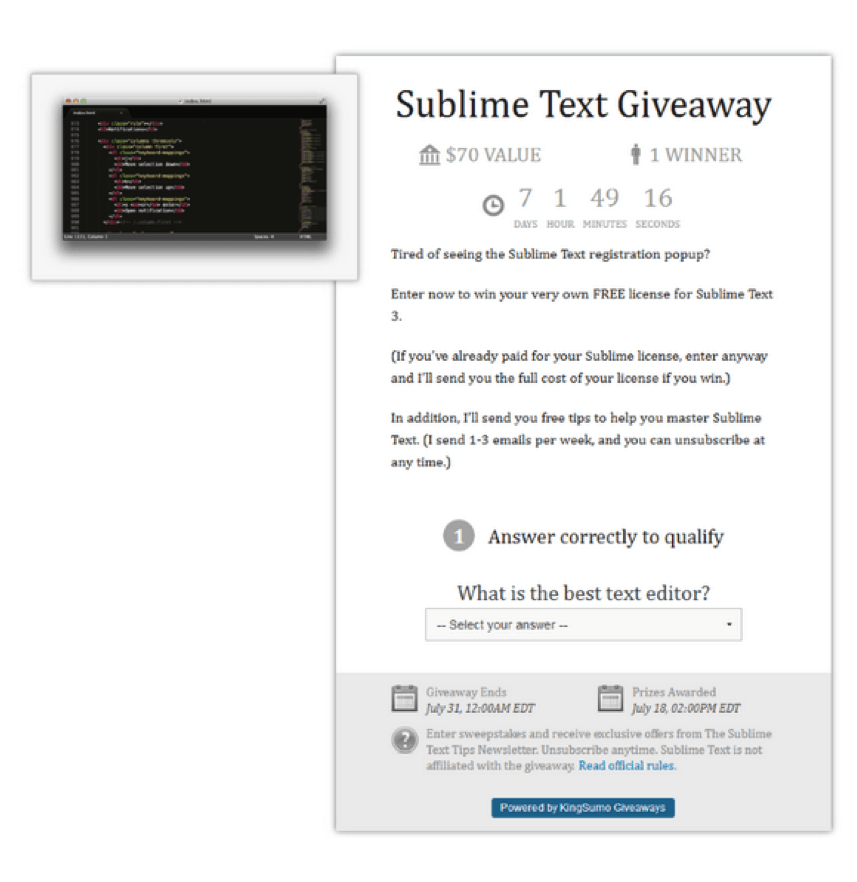
Using the WordPress plugin KingSumo, Josh created his giveaway. His prize was a free license for Sublime Text, which is valued at $70. With his prize chosen and giveaway set up, he took to social media and his current list to spread the word about his offer. After 11 days of promoting his giveaway, these were Josh’s results:

  • He collected 187,991 email addresses.
  • His website received visits from 398,896 unique visitors.
  • Thanks to the flood of tweets that mentioned his contest (and included his Twitter handle), his Twitter following more than doubled, from 13,460 to 32,427.
  • The massive, sustained flood of traffic had a great impact on his site’s Alexa ranking. He leapfrogged 2,043,911 other websites and became the 49,137th most popular site on the Internet.

sublime-text-giveaway

The success of Josh’s giveaway was not a fluke. There are two major reasons it succeeded:

#1 – He used his prize to attract highly qualified subscribers.

Choosing the right giveaway prize can be tricky. If your offer appeals to an audience that is too wide, you could end up with a massive list of unqualified leads. But if your offer appeals to an audience that is too narrow, you could hurt your giveaway’s chances of being shared far and wide across the web. This is a delicate balance that Josh nailed.

Josh gave away a Sublime Text license. This is a product that he knew had a substantial and established market value. He also knew the only people who would enter to win his giveaway were people familiar with, and maybe even regular users of, the text editor. These were his kind of people – people he knew he could sell to if he could get them on his list. And he did. Josh’s first book Sublime Productivity, which he promotes with his email list, has sold more than 2,000 copies and earned him $38,000, and counting.

The important lesson here: Your prize is one of the easiest and most effective ways to attract qualified leads. Choose it wisely.

#2 – He leveraged the self-interest of others.

Josh figured out early on that most giveaways perform poorly because businesses rely on their entrants to act against their own self-interest.

What does this mean exactly?

When a business asks entrants to pass along information about a giveaway contest after submitting an entry, the entrants think something like this: “The fewer people who know about this awesome giveaway that I really want to win, the better chance I have of winning.” Then, to the detriment of the contest, they decide, “I’m not going to tell anyone.”

Thus, many giveaways never gain traction because people aren’t willing to share an offer if it means acting against their own self-interest.

So, how do you make people feel good and excited about sharing your giveaway? You incentivize sharing to work in their favor, not against it.

This is what Josh did: When a person submitted their entry, Josh had an entry confirmation autoresponder set up that plugged an additional offer. Each person who would share a special “lucky URL” (a unique link to his giveaway) and assist a new giveaway entrant would receive three extra chances to win. Doing this allowed Josh to engineer his giveaway for virality.

Tootsie Roll Gathered 43,292 Email Addresses and Secured 400 “Taste Testers” in 3 Days

When the iconic candy company Tootsie Roll released a brand new lollipop flavor in a limited number of stores, it didn’t generate too much buzz initially. Before hitting the global market, the company wanted to increase its brand awareness and receive feedback on the new lollipop flavor to make sure it would be a success.

To accomplish both of these goals in a small window of time, Tootsie Roll organized a giveaway. Using ShortStack, they built a branded landing page for their giveaway, allowing their fans and followers to enter for a chance to be one of the exclusive taste testers of Tootsie Roll’s latest pop flavor. After sharing their name, age, email address, and mailing address, entrants were narrowed down and sent samples of the lollipop with a survey for feedback.

enter-for-a-chance

Tootsie Roll mainly wanted to interact with their Facebook audience, so they promoted their giveaway to only that audience. They posted organic status updates and invested in boosted page posts. After just 3 days of promoting their giveaway, these were Tootsie Roll’s results:

  • They received 43,292 entries. This was a 702% increase in entries over a similar promotion they had run in the past.
  • Their promotion reached more than one million people.
  • From their 43,292 entries, they secured 400 taste testers, exceeding their original goal of 100. The 400 Taste Testers were mailed a Tootsie Roll Pops sample pack that included a printed insert with a Quick Response Code (QR code) that took testers to a survey with 10 feedback questions about the new pop flavor.

Results like this don’t just happen unless you’ve done a few things right. Here are the two major takeaways we can all learn from Tootsie Roll’s giveaway:

#1 – They hosted their giveaway on a landing page that was independent from Facebook.

While Tootsie Roll was looking to engage with only their Facebook audience, they wanted entry to be as seamless as possible. Publishing their giveaway as a landing page ensured that their mobile and desktop fans could participate in their giveaway without any barriers from Facebook.

#2 – They treated their giveaway as an investment.

To give their promotion momentum, Tootsie Roll made the choice to pay to play. They used a small advertising budget to extend the reach of their campaign beyond their organic audience. This investment paid off for Tootsie Roll, as they were able to increase the reach of the post promoting their giveaway by 587%.

JewelScent Grew Their Email List by 3,431 New Subscribers and Made $18,776.49 in 8 Days

Two years ago, an innovative fragrance products company called JewelScent launched. What makes JewelScent different from all their candle, hand wash, and aromatherapy competitors? Hidden inside each of their products is a jewel valued from $10 to $7,500.

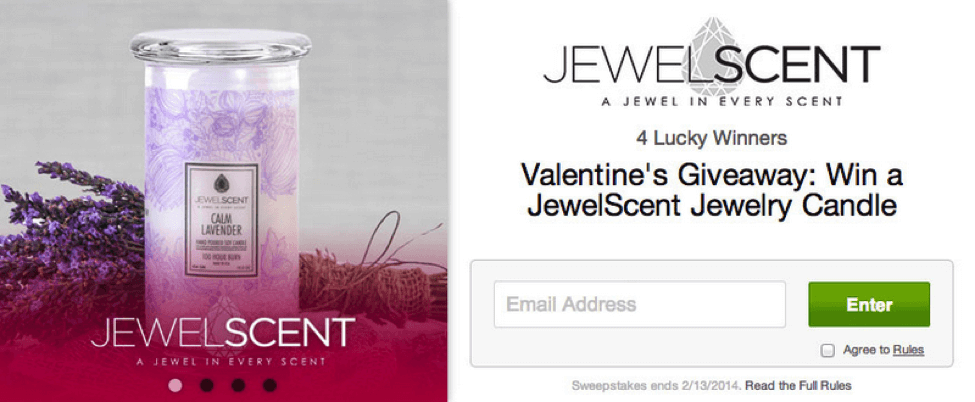
To rev up sales and create awareness for one of their most popular and sought-after products, their jewelry candle, JewelScent hosted a giveaway the week before Valentine’s Day. Using the tool ViralSweep, they set up their giveaway with a single entry field. To enter to win, entrants simply had to share their email address.

jewel-scent

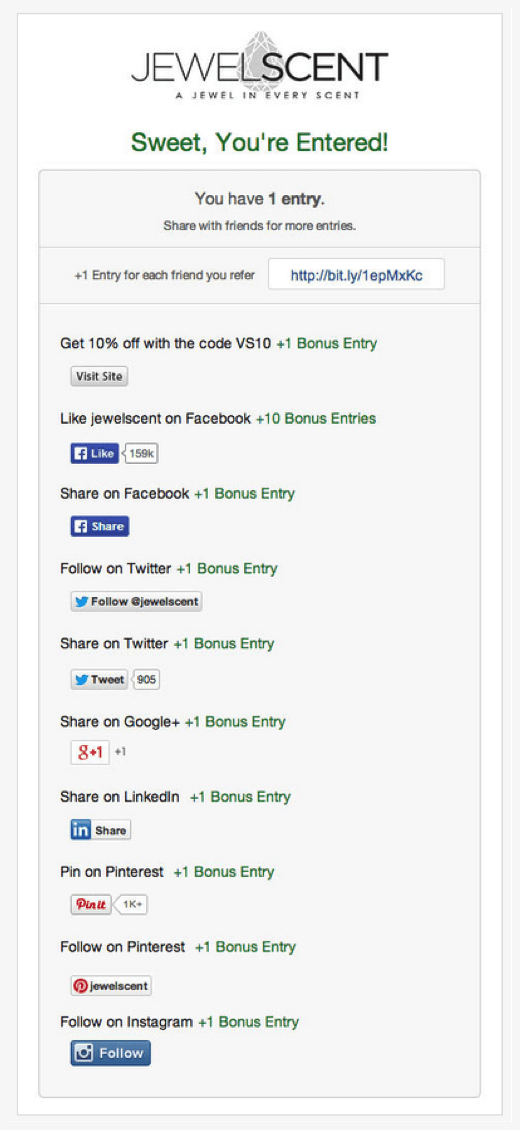
To encourage sharing, after a user pressed “Enter,” they were presented with several social media sharing options. Each share meant the entrant earned additional entries into the giveaway.

jewel-scent-social

Just 8 days after announcing their Valentine’s-Day-themed giveaway, these were JewelScent’s results:

  • They received 15,675 entries, 3,431 of which were from new people who JewelScent did not yet have on their email list. This meant that about 22% of the people who entered their giveaway were entirely new people brought in by JewelScent’s current network.
  • They generated $11,659.33 in direct revenue and $7,117.16 in indirect revenue. This comes to a grand total of $18,776.49, which is $2,862.35 per day over the length of time the giveaway was running!

JewelScent did many things right with their giveaway, but here are the two decisions that made the greatest impact:

#1 – They used tracking links to measure the monetary return of their giveaway’s efforts.

When JewelScent started their giveaway, two of their biggest goals were to grow their email newsletter list and drive revenue. These two things do not always go hand in hand, but in JewelScent’s case they did.

Why? Because they did the proper legwork that needed to be done once they collected their data (more on this in the next point). What’s more, they used a tracking link on the button that people would click to go to JewelScent’s website after they entered the giveaway. This helped them to know whether or not their giveaway produced sales.

#2 – They kept in constant communication with their entrants.

Email marketing played a significant role in the success of JewelScent’s giveaway. Throughout the duration of the promotion, their team communicated with their entrants via Facebook and email. Even after their giveaway ended, everyone who didn’t win was sent an email with a 10% off coupon. This effort generated $7,117.16 in revenue.

The takeaway here: A giveaway is not valuable unless you put the data you collect to work for you. It’s what you do with your list (i.e., how you sell to your subscribers after your giveaway is over) that matters most.

Final Thoughts

Giveaways can be an excellent option if you want to accelerate the growth of your email list. That said, there are still no shortcuts to the top. Climbing a mountain, even if you have assistance, is never a walk in the park. To truly reap the rewards of offering a giveaway, it’s imperative that you strategize, invest your time and other resources, and make use of all the information you collect to forge new relationships and drive sales.

Have you ever hosted a giveaway to help grow your email list? If so, sound off in the comment section below. I’d love to hear your stories!

About the Author: Chelsea Hejny works as a content creator at ShortStack.com, an online tool you can use to build your business’s social media marketing campaigns, promotions, and landing pages. Want to chat with her about using a giveaway? Shoot her a tweet to get the conversation going.

Thursday, July 2, 2015

5 Articles That Will Turn You Into a Data-Driven Social Media Marketer

Laughing_Data
You mean to tell me you’re not using data to direct your social media efforts?

Social media marketing is often used to pull in new followers at the top of the funnel. People cast a wide net but in many cases, completely miss the mark when it comes to tracking their efforts.

They neglect to set concrete, measurable goals – in other words, they neglect to run structured social media campaigns.

Why should you be running social media campaigns? They are the rudder that steers the boat in a particular direction, charting the course for your activities. And setting finite start and end dates allows you to track your progress so you can iterate and get even better results.

If you’re not using data to direct your social media campaigns, then you’re missing out on massive opportunities. The opportunity to get to know your audience better, the opportunity to reach a larger audience, and the opportunity to fully understand the results of your efforts… so you can optimize them accordingly.

So how do you get the most out of social media with data?

If you want to become a more data-driven social media marketer, you’ve got to learn from others who are already doing it well – and the web is overflowing with articles that can help on that front.

We’ve rounded up five articles that break down how you can use data to get the most out of your social media campaigns.

Ready to reap the benefits? Read on.

1. How to create buyer personas with social media data by Pierre Borodin for Hootsuite

On landing pages and on social media alike, you need to know your customers’ needs before you attempt to speak to them. For that reason, buyer personas are a part of the foundation of any successful social media marketing campaign.

As this article from Hootsuite by Pierre Borodin outlines, buyer personas are representations of the people who are buying, or might buy, your product. With buyer personas, you ‘re able to understand your customers better.

By more fully understanding your customer through buyer personas, you are taking the first step toward creating campaigns that really speak to their needs.

buyer_personas_with_social_media_data

In order to get the best information to create buyer personas, you need data. And guess what?

You can collect that data through your different social media channels.

Facebook Insights, Twitter Analytics, LinkedIn Groups and other tools contain the information you need to learn about your customers in and out.


Crafting buyer personas? Glean insights about your customers through social media analytics.
Click To Tweet


This article explains that by listening to your customers through these channels, you’ll build models that clearly outline who your customers are, which will ultimately allow you to create the right messaging for that audience.

2. Why we stopped focusing on direct social media ROI: a new way of measuring conversions by Kevan Lee for Buffer

With the rise of several tools that allow marketers  to calculate social media ROI, many articles are pushing the importance of tracking the impact of your  social media campaigns on your bottom line.

But all too often, these articles focus  on “clicks” or “conversions” – failing to account for the fact that everyone makes their journey to conversion a little bit differently.

In this Buffer blog article , Kevan Lee explains how Buffer has started to look at social media ROI a bit differently – by tracking deep down the funnel.

To illustrate this concept, Kevan explains how he started using Buffer (a social media scheduling tool) months before he started working there. He breaks down the story of his journey toward conversion, and how that journey included a lot more touch points than just social media:

social-media-data-journey
Kevan discovered Buffer on Facebook, read the blog, and then continued to return to the site through various means and social media channels before finally converting.

Kevan goes on to explain why Buffer is measuring email signups as their number one social media campaign goal, with conversions from their blog as the number one metric.

The point is to create a base of engaged customers who, while they may take their time to convert — and may not do so directly from a social media click — have all the resources they need to make an informed decision.

3. How does social media affect SEO? by Andy Crestodina for Orbit Media

If you’ve ever wondered whether social media affects SEO, this is the article for you. As web strategist and co-founder of Orbit Media, Andy Crestodina, points out:

The answer: Yes. But not how you think.

As Andy explains in this article, social media doesn’t affect SEO because of the social links themselves, but because people are spreading the word about your content.

If the content is noteworthy, if it provides value to readers, they will link to it (like I’m doing here). Those incoming links help to build authority for that page, which helps search engine ranking.

search-factors

In the end, the point is to have content that people want to share, and that those who read it will want to talk about.

4. Hashtags aren’t gimmicks by Jordie Black for KISSmetrics

KISSmetrics has data that shows how hashtags can help businesses share more effectively. A hashtag does not have to go viral every single time — hashtags can be used for increased audience interaction through Twitter chats, as Jordie Black points out.

Buffer uses the hashtag #bufferchat every Wednesday. From the article:

Twitter chats are a perfect way to show your audience you are listening. It’s a way to understand your audience and find out what it is they want to know. It’s a way for your audience to ask you questions and get answers.

When this article was published, Buffer had achieved the following with #bufferchat:

  • 113,658 Tweets
  • 8,170 Contributors
  • Total Reach: 49,993,695

Buffer has reached almost 50,000,000 people on Twitter with #bufferchat
Click To Tweet


Buffer manages to reach a wider audience through the people they are connected with on Twitter, as we see below.

social-media-influencers

Through these followers and the interactions through the hashtag, they’re able to reach a much wider audience.

Because these followers also have a large number of followers, those who are following them get to see the interaction, and are made aware of the hashtag and, subsequently, they become familiar with Buffer.

In a nutshell, this article explains that by using hashtags as both a connection and a listening tool, you can get a lot more out of social media than you would by just waiting for people to find you.

5. How many Facebook fans visit your website or convert? by Jon Loomer for JonLoomer.com

What is the value of a Facebook fan? Jon Loomer, a Facebook marketing consultant, wanted to find out, and he shared his findings in this post.

To get to the true value of a fan, you’re going to have to go past your Facebook Insights and Google Analytics.

facebook-fans-website-visitors-180-days
A look at the process of building targeted audiences for Facebook ads. Image source.

Jon outlines the process of setting up custom audiences in Facebook, which can then be used to learn the true number of visitors your website receives by segment. From there, you can drill down to the number of fans who converted. Jon says:

We often hear about uncertainties regarding the quality of fans. Well, I know that 31% of my fans have visited my website during the past 180 days. Considering my page has been around for more than 3 1/2 years now, I consider that to be quite good.

What he’s found out is that he has managed to build a quality audience. By following Jon’s method, you’ll be able to find out for yourself the real value of your Facebook fans with real data – and ultimately assess the ROI of your efforts on social media.

The proof is in the putting (it on social media)

Using data to direct your social media campaigns allows you to make more educated decisions about your campaigns. You’ll find out how well they’re doing, and you can use the information to create more successful, results-driven campaigns in the future.

Have you read an article that has helped you social media marketing? Tell us about it in the comments below!