Thursday, June 18, 2015

A Legendary Copywriting Formula 4 U [PODCAST]

blog-cover
This simple formula will help you delight readers and attract qualified customers… every time. Image by J. Pellgen via Flickr.

In this episode of the Call to Action podcast, we explore how to write amazing landing page copy.

First, we tell a story of what happened when we made our “About Us” page copy a little bit too much… about us.

Then, Unbounce’s Dan Levy talks to direct response copywriter Marc Aarons about embarrassing writing habits and an easy-to-remember landing page copywriting formula for making sure you’re simultaneously delighting readers and attracting qualified customers.

Listen to the podcast


Listen on iTunes.
Prefer Stitcher? We got your back.

Mentioned in the podcast

Read the transcript

In this episode: Dan Levy, Unbounce’s Content Strategist, interviews direct response copywriter, Marc Aarons.

Dan Levy: Copywriting is kind of a tough thing to talk about because it, on the surface, seems kind of personal and specific to each company and their audience. Can it really be boiled down to a formula?

Marc Aarons: Yes and no. So it’s such a great question because formulas – I like to think of formulas almost like frameworks. They get us started, and they get us very close to the target. But at the end of the day, you’re always going to want to customize your entire sales message, your landing page, your sales page, video sales letters – whichever advertisement you’re actually creating for your audience. You always want to customize it specifically for them. We always start with the audience.

Dan Levy: So tell us about the 4 U Formula. How did that come about, and what are those 4 U’s anyway?

Marc Aarons: The 4 U Formula was actually developed by Michael Masterson, and he is best known as a serial entrepreneur. He is also a direct response copywriter, and he helped grow Agora Inc. – I think their financial division – from somewhere in the single digit millions to a nine-figure company. And he developed a number of techniques and innovative strategies that are now taught through the American Writers and Artists Incorporated, one of them being the 4 U Formula. And the 4 U Formula really breaks down into four questions. Is this useful? Is this unique? Is this urgent? And is it ultra-specific to our audience?

Dan Levy: Right. I want to get a little more specific there. But first, this post is about using the 4 U Formula on your landing pages in particular. And you say to either pick your headline or your subheadline or your benefits, which are usually in the bullet points of your landing page, when going about using this formula on your pages. Is there a particular one that you should start with?

Marc Aarons: So the beautiful thing about writing copy for landing pages is every single direct response copywriter that I’ve spoken to, they start in one of two places. Either they start in the body copy, which here, would be the benefits. Or they start with the headline/subheadline. So it’s either an inside/out or outside/in approach, if you will.

Dan Levy: Okay, so either start with the first thing you see on the page, or start with – well, actually, how about the call to action button? Where does that come in? Because I was going to say that’s sort of what the page is culminating toward, right?

Marc Aarons: Right. You know, the call to action, I would personally leave that to be the very last thing that I actually write because in the writing process, it’s like Anne Lamott says in Bird by Bird, “You have characters in your story. And as you write your story, they’re going to involve because you’re still getting to know your characters.” And writing a landing page or a sales page or even a video sales letter, it’s very much the same. You’re going to be learning a bit more about your audience and the message that you want to convey as you write the first draft, then re-edit the first draft to get to your second and third. And once you’ve got to your third, once you’ve got the final core message to offer the benefits, then the call to action button – and for some copywriters, the headline – is almost like the icing on the cake.

Dan Levy: That’s really interesting. The copywriter Joanna Wiebe talks about starting with your page goal, the call to action button, and working backwards. But here what you’re saying is as the page evolves, sometimes that call to action button might change.

Marc Aarons: Yes, absolutely. It can change. However, we always start with the plan, and the purpose of the plan is not just to stick to the plan, but to allow you to deviate from the plan if a better plan starts to make itself available to you.

Dan Levy: That’s what you were saying before. A formula is a great place to start, but you have to remain flexible.

Marc Aarons: Yes.

Dan Levy: So the goal here is to nail at least three out of those four U’s. But if you don’t, how would you go about revising that copy?

Marc Aarons: This is also a great question because it brings us right back to the heart of every single landing page and sales message: who is our audience? What is it that they want to accomplish? So if we’re going to ask ourselves – say, for example, we want to make a headline more useful. The question that we’re asking is: does this provide value to the visitor? Or, does it imply that there’s going to be value found if they actually click through and opt in or purchase something? So we start with that question, and then we contextualize it for the audience.

Dan Levy: Okay. Before we go into some examples of this, I’d love to hear a little bit more about your writing process. Do you have any specific techniques for getting started writing a landing page, like templates or a spreadsheet filled with notes and ideas?

Marc Aarons: I love this one because my writing process is something that I’ve refined for maybe five plus years now, and it always starts with research, and there are actually three kinds of research. And this is getting, probably, a little bit deeper than we need or –

Dan Levy: No, I love it. Let’s get into the weeds here.

Marc Aarons: Oh, cool, perfect.

Dan Levy: Let’s get nerdy.

Marc Aarons: I totally love this part. So we have three kinds of research. You have customer research, you have product research and you have competitor research. And the purpose of customer research is to understand what it is that your audience finds most valuable. What are their burning pains? What are their hopes, fears and dreams? What are their wants and aspirations?

And from there, we get into product research. We are going to look at our product, or even maybe our service, to then find out, “Okay, what’s the unique selling proposition, what differentiates us from everybody else that’s out there? And how does our product specifically address the wants and the fears and the frustrations that our customers are going through that we uncovered in our customer research?”

The third kind of research is competitive analysis, or competitor research. Then we look at everyone else, maybe even just the top three competitors that are out there, to see what it is that they’re offering, what their unique selling propositions are. Because once we know what else our customers are looking at, then we know how to differentiate ourselves from the competition and everything else that’s out there.

Dan Levy: Right. So once you’ve done all this research, how do you collect that into one place and then go about turning that into great copy?

Marc Aarons: Oh, so that’s also a great question. I like to use just one document to brain dump everything in, and it’s almost like writing the first draft. The research – you want to separate your research process into collecting and then organizing your data. And if you’re doing it for a client, then there’s also the reporting process as well where you’re going to make it legible or understandable for your client. So the first step, you go through the research process, you collect everything, and you put it into those three different sections – the customer, the product research and the competitor research.

Dan Levy: Is that like an Excel spreadsheet or Google doc or something like that?

Marc Aarons: Great question – Google doc. You can use an Excel spreadsheet. However, I actually use a combination of both. I use Google spreadsheets as well as Google Docs. Google spreadsheets, especially, if I’m going to be going through a lot of blogs and blog comments and reviewing a lot of books on Amazon and things like that because that just keeps it neatly in one place. Then I’ll actually go into a Google document to create the narrative because I need to summarize it to about just one to two pages, which allows me to glance at it as I’m actually writing so I don’t get stuck in the writing process.

Dan Levy: Yeah, I feel like we all have these secretly shameful, messy documents where we dump all our ideas, and then we have to go about cleaning that up and putting it into some sort of narrative for our client or just to make some sense out of it.

Marc Aarons: Always. I definitely get messy in my process as well. And then afterwards, to make myself feel like a good human being, I’ll go clean it up.

Dan Levy: Totally. In your post, you take a close look at a landing page by Noah Kagan for an email marketing course that he was involved with. So the page passes the 4 U test, but you suggest that he could actually improve on one of his 4 U’s by adding more urgency. Can you break this one down for us?

Marc Aarons: Yeah, sure thing. He did many things there as well, but for us to up the urgency factor, we could show through social proof how many other people are actually taking this course as well. So if we say something like, “Join 5,000 other sharp marketers,” or whatever the specific number is right now, then that may trigger someone who’s reading it to say, “Oh, wow. Everyone else is doing this, and they’re getting ahead of me, and I don’t want to get left behind. So let me go ahead and opt in right now before all of my other competitors and everybody else gets the jump on this.”

Dan Levy: You also say later in the post, though, that urgency can actually backfire sometimes. How so?

Marc Aarons: Totally. So if you push too hard – and this comes right back to knowing specifically who it is that you’re talking to – because if you push the envelope too hard, it’s almost like the used car salesman who’s trying to get you to buy, buy, buy, buy now. It is like, “Whoa, why are you trying to push this so hard?” Maybe it actually isn’t that good, which totally goes into this whole deeper thing of demand and supply and all that kind of stuff. But if you push the urgency factor too high, it will actually repel the person that you’re trying to target, and it may actually attract the wrong kind of person because if you use too much urgency, then you’re going to be attracting people who act on impulse and who respond to that. And you’ll have to continue to sell to them because that’s the customer that you now have in your sales funnel.

Dan Levy: There’s a carpet store that’s on my corner that’s been going out of business, I think for six or seven years now. So it’s like, “Act fast,” and I think a lot of customers can see through that. But that’s an interesting point, too, about attracting the wrong kind of customer on unqualified leads or customers that are ultimately going to be a drain on your resources – maybe on the customer success side.

Marc Aarons: Absolutely.

Dan Levy: You mentioned a statistic that Brian Clark of Copyblogger and others have written about, which is that 95 percent of the most effective headlines from the early years of magazine advertising were actually eight words or fewer. Eight words aren’t that much, really, but are eight words really enough to be ultra-specific about a complex offer?

Marc Aarons: The answer is, again, yes and no. It depends on the offer so I actually want to give both examples. So in the example where it’s “yes,” then sometimes it’s actually possible to really boil it down and really just get the core benefit or the core driving question down. And speaking of core driving question, that gets a little bit into the “no” part because the real purpose of any headline and subheadline is to just get them to continue reading the copy. That’s it. You just want them to read on. That is the whole purpose. And once they read the first line, the purpose of the first line is to get them to read the second line, and so on and so forth until they get to the call to action. And then finally, the whole purpose of all of that buildup is to then get them to click that button, opt in, or make a purchase.

Dan Levy: Right. To go back to the yes and no thing and your post – with the caveat that of course all of this needs to actually be tested on your landing page. But you say if all else fails, you could seduce them with empathy. Recently, I actually spoke to Andy Crestodina about approaching your content marketing with empathy, but what does empathy mean in regards to copywriting?

Marc Aarons: So this is a great question, and I actually think of BrenĂ© Brown and her Ted talk on empathy, which if everyone hasn’t gotten a chance to look at it, I would highly recommend it. But what she says is empathy is feeling the emotions that someone else is feeling, and it can actually be taught and practiced. And the way that comes into copywriting is the best sales pages of – I was actually recently at a nine figure direct response company just earlier on this weekend, and everybody agreed that as you’re writing the copy, the more you can visualize one single person that you’re writing this letter to is the better the copy comes out. Because that’s exactly what it is – it’s writing a letter. So if you can have empathy for the single person who is the customer avatar of your audience, then you’re headlines get stronger, your subheadlines get stronger, your calls to actions get stronger, and your bullets and benefits also get stronger.

Dan Levy: I have to admit that as a writer myself, sometimes the idea of applying formulas to the writing process feels – I don’t know. I’m not going to say soulless, but in some ways, the opposite of a more human-centered approach. You seem to be suggesting that this kind of framework can actually help you be more empathetic, which is interesting.

Marc Aarons: Yes. It’s so funny because formulas I kind of see as boundaries. They’re almost like the walls of a house. We know that when we walk into a house that we’re safe. We’re home. Those boundaries allow us the freedom to express ourselves within this safe space. So in some ways its structure can provide freedom.

Dan Levy: Yeah, that’s the way it is with any parts of the creative process. When you’re given just a blank page and told, “Free write,” it’s super, super daunting. But when you’re given some sort of boundary, some sort of guideline, then all of a sudden, it kind of opens that creative part of your mind.

Marc Aarons: Absolutely.

Dan Levy: Great. Thank you so much for taking the time.

Marc Aarons: Likewise.

Transcript by GMR Transcription


Tuesday, June 16, 2015

The Top 7 User Onboarding Tools to Grow Your Business and Improve Your Conversion Rate

Now that you’re acquainted with the user onboarding process, you may be wondering just how to get the most traction out of it. “Improving the signup process” is a tall order to fill, and you may feel overwhelmed when trying to juggle all the little pieces that make up the whole experience. Thankfully, there are a variety of tools to help you help users get more comfortable with your offer. Here are some of our favorite onboarding tools that span a variety of uses, ranging from email to demos:

Tutorial-Based User Onboarding

Sometimes, your prospective users need a little extra help getting to know your system and how it can work for them. A simple FAQ may not be detailed enough, but a video walkthrough may be too much to sit through and try to understand. Tutorial based onboarding can be used to provide users with contextual help.

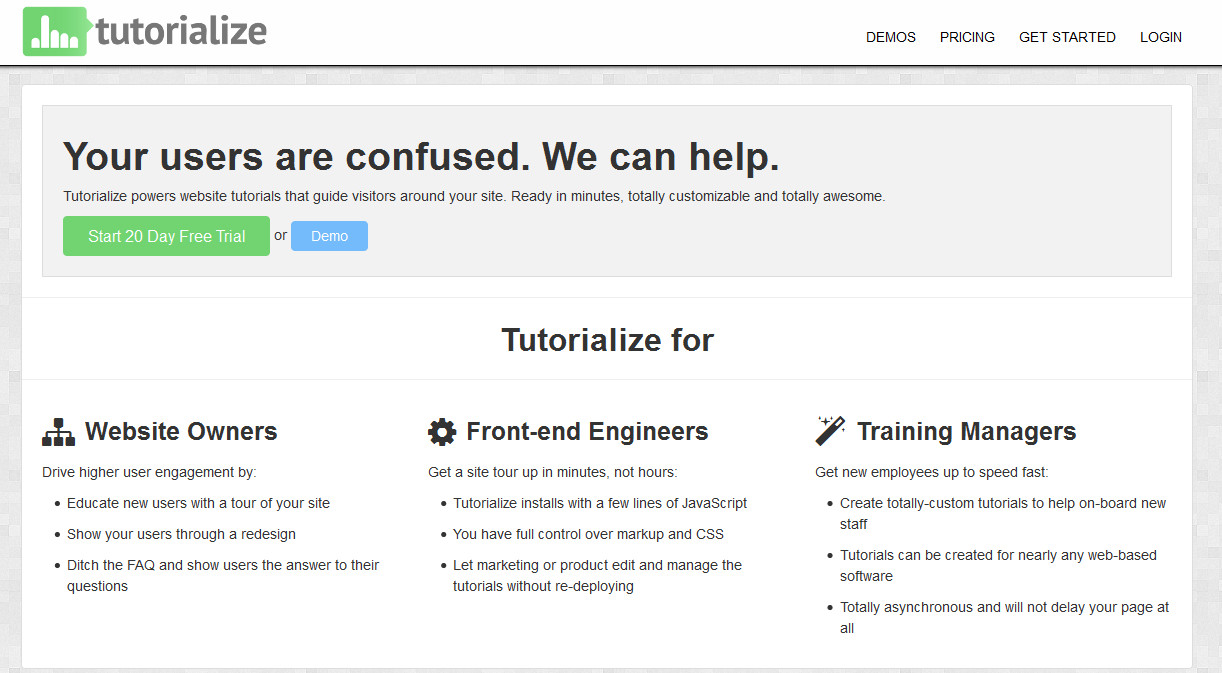
Tutorialize

Tutorialize lets you add tooltip-style actions to your site or web based service. You can show the number of tooltips in the tutorial or stop it early. As part of the interactive demo, you can highlight certain parts of your site or service while other parts remain shaded, similar to a lightbox effect. Try the on-site demo for an example or start a 20-day free trial. Pricing starts at $14/month but includes company branding on the last slide. A non-branded version is available for $34/month.

tutorializeAdd custom tooltips to create a tour of your site or system

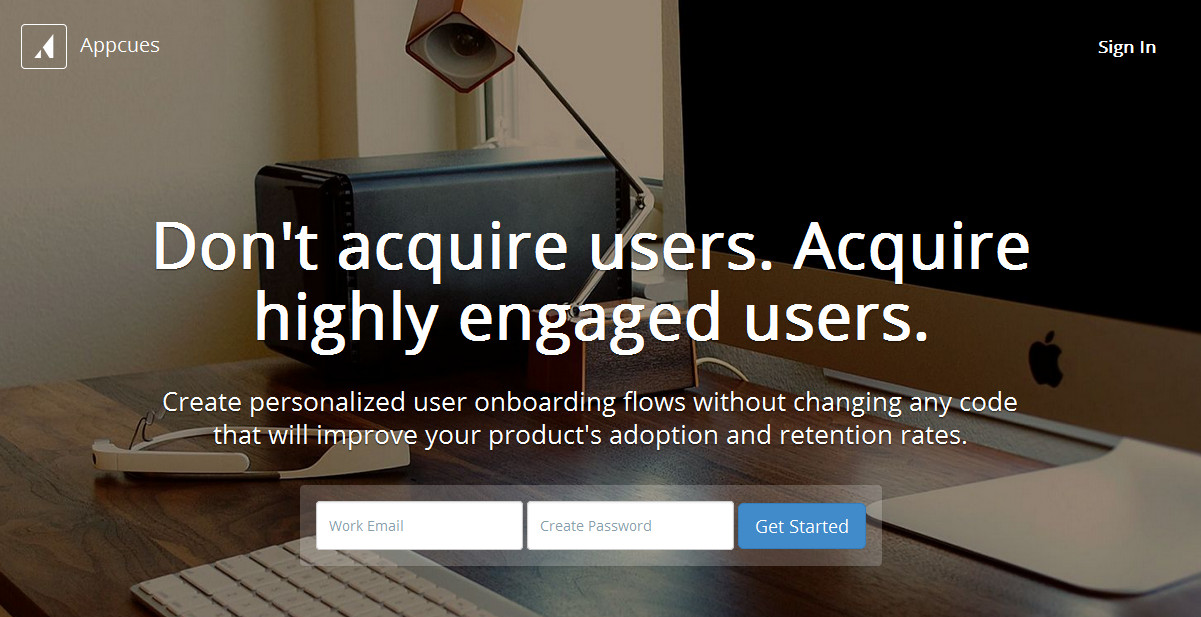
AppCues

If you need something a bit more robust to guide your users through your site or SaaS, consider AppCues. Similar to Tutorialize in that you can put sticky tooltips on your site, AppCues goes a bit farther in terms of customization. You can also include a full-screen “Welcome” page, a slide out or an in-app alert.

AppCues also offers the ability to segment users, so only certain groups see the announcement or tooltip, so you can track how well your new demo walkthrough is performing in terms of converting customers. AppCues starts at $45/month for up to 250 active users. The number of users goes up significantly with higher pricing tiers.

Oh, and did we mention that AppCues works beautifully with KISSmetrics too?

appcues

AppCues lets you segment users according to behavior and deliver custom styles of instruction

Email-Based User Onboarding

Sometimes you don’t need an on-screen tutorial so much as a way to guide users to get help when and where they need it. Traditionally, this involved a variety of solutions, including live help, a helpdesk/knowledgebase system, email-based support and so on. These outdated methods mean that you could lose a customer at any one of those steps. With email based user onboarding, you can prevent these losses while unifying your support into a more streamlined, analytics-based system.

Intercom.io

Intercom is a multi-pronged support platform that lets you observe what’s happening on your site, as its happening.   Where it truly shines, however, is in its email and in-app-based engagement system. For example, if you just released a new version of your software program, and wanted to update users who downloaded the previous version just a day ago, you can simply create a filter through the Intercom dashboard, and those users will be immediately visible. Then, just type in your announcement, and they’ll see it the next time they log in. This process works via email as well as in the app itself.

intercom-video

A video explaining Intercom.io’s “customer engagement” features

A simple slider-based pricing system lets you customize how much you pay for Intercom based on the number of users you have, and the end goal you want to achieve. For example, observing customers costs you nothing, while engagement, the package in the above video, has both a basic and pro plan with various integrations and features depending on your needs.

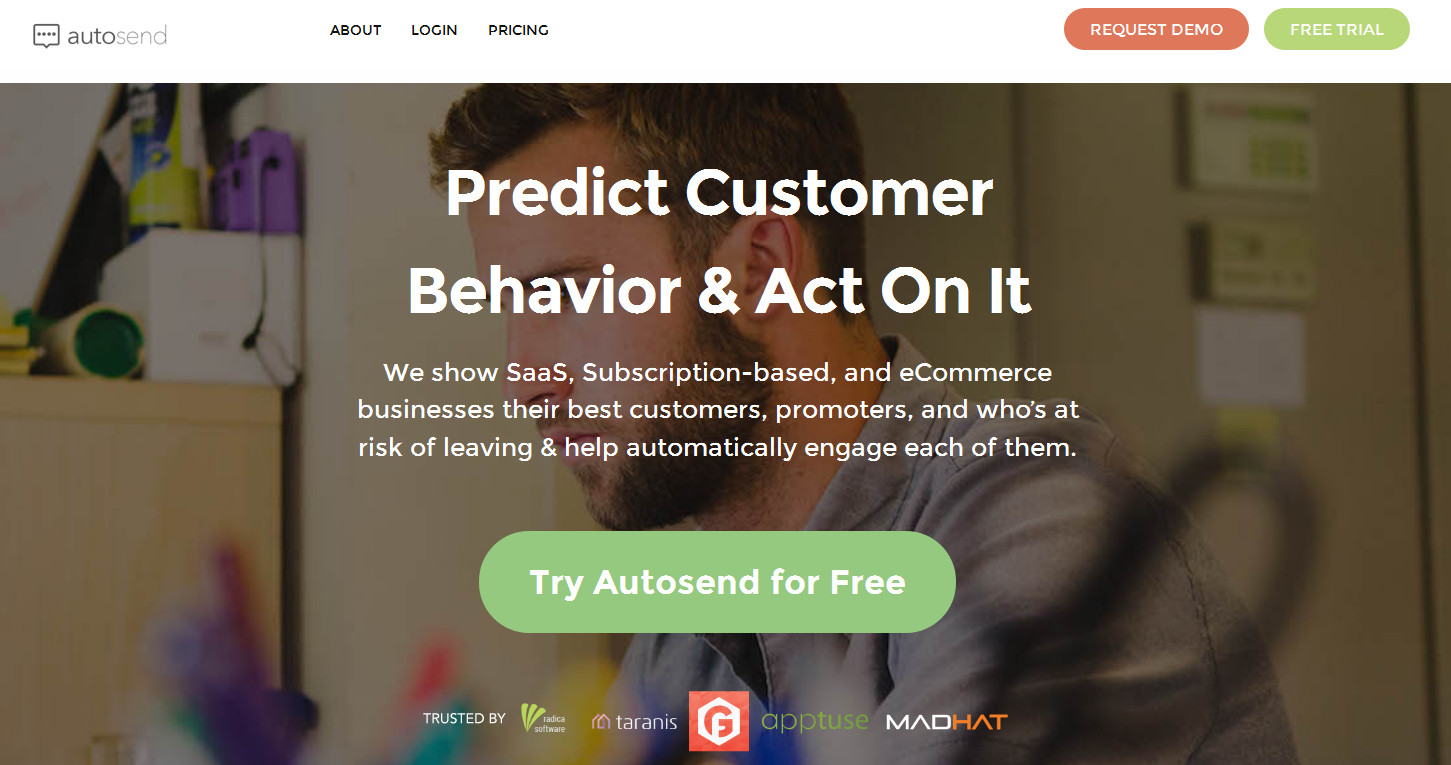
Autosend

Autosend’s main focus is to help you avoid losing customers at various stages of the product acquisition lifecycle. Autosend is driven by a customer’s behavior, so if it looks like they’re about to drop off due to lack of interaction with your product, you can send a gentle email, SMS or in-app message to guide them into the action you want them to take.

autosend

Perhaps one of Autosend’s best features is that so much of the system is already built from the ground up to perform. It has split testing capabilities and takes just a few minutes to set up with no coding know-how whatsoever. It also integrates with a variety of systems to help you create filters based on your best customers, your at-risk customers and more. You can also craft up-sells, down-sells and a variety of other options through the intelligent dashboard system.

Autosend starts at $199/month for up to 3,000 customers and comes with a free trial.

In-App Messaging

Many of these tools offer in-app messaging as one of the many features to their systems. But if you don’t need all the extra features and only want the instructional guidance of an onboarding system for your app, you’re in luck. There are several services on the market that are targeted to just apps and app developers, including:

Tour My App

Tour My App is a simple tool-tip system similar to Tutorialize. You can customize every aspect of the sticky note and see precisely how and when users interact with the tour. You have full control over how the tour appears, so users can’t simply click “Next” to skip through it. Rather they’ll need to complete a certain action, like typing or clicking, to continue. Tour My App also has some advanced features in that it supports dynamic elements and AJAX. It also tracks who has seen the tour so that they don’t see it again (unless you have an update).

tourmyapp

Of course, if you need to make changes and update your tour for a new release, that’s easy as well. The finished product is a few lines of JavaScript that go effortlessly into your app.

The starter package is just $14/month, but the more advanced pricing tiers support features such as multilingual tours and funnel based analytics.

Miscellaneous Onboarding Tools

There are times when you really wish you had just a bit more precision in your onboarding process or the ability to create more of a training system that brings all the benefits of a good user experience to your employees. We’ve got you covered too!

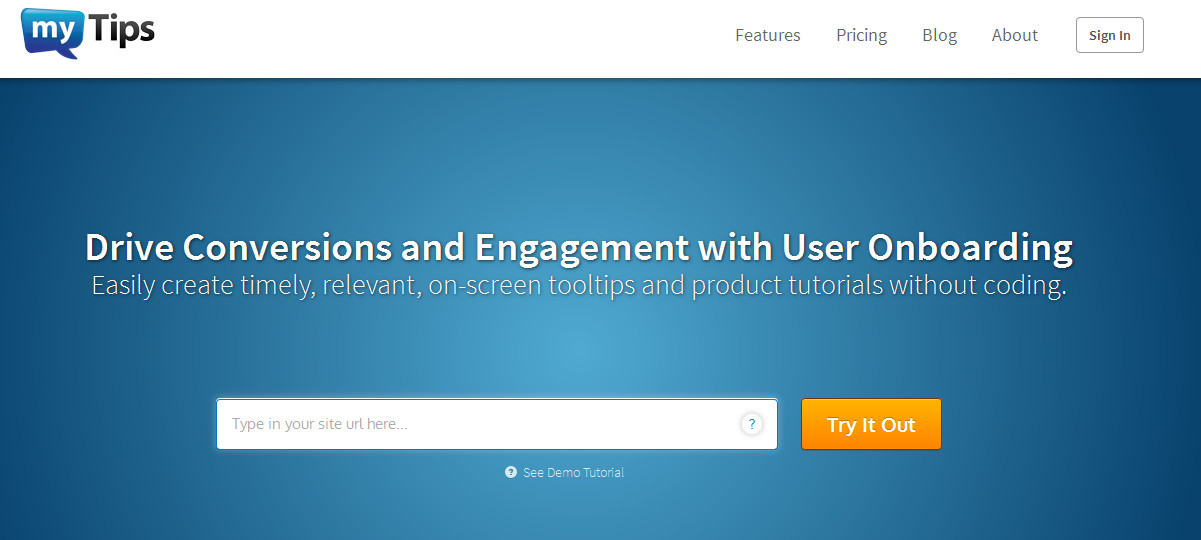
MyTips.co

What if you had an onboarding system that would display landing pages based on smart segmentation? With MyTips.co, you can. On-screen tooltips can be delivered to just about anyone that fits just about any criteria. Want to display tooltips to users from a certain city? Want to show tips to only people who visited your pricing page? Done and done.

mytips

It comes with robust analytics too, so you can see just what effect your guided tour has on your users. And did we mention it happens to integrate beautifully with KISSmetrics? MyTips.co has a free package for up to 5,000 unique users and 3 tutorials/tooltips. Paid packages start at $59/month for up to 25,000 users and unlimited tutorials/tooltips as well as analytics.

Trainual

What if you had all the benefits of a detailed employee or user manual, but could see precisely how your employees or users interacted with it from an educational-based standpoint? You can embed nearly any type of content into Trainual, then add your team, and see where they may be struggling with material. You can also segment users so that they only see the training they need to, and are gated off from the rest.

trainual

In addition, Trainual will show you who completed what and when. See how far users or employees progressed in their training and email them a gentle reminder that there are new documents, videos or other files to learn from.   There’s an internal knowledge base too, so if they get stuck, they can always reach out and ask questions while other employees step in and lend a hand.

As with any effort, tools aren’t meant to replace testing or insights. When used together as part of your overall campaign and marketing strategy they can augment your existing work and help you learn valuable details about the very groups you’re working hard to attract.  With that being said, have you used onboarding in your marketing? What are some of your favorite tutorial and documentation tools? Share with us in the comments below!

About the Author: Sherice Jacob helps business owners improve website design and increase conversion rates through compelling copywriting, user-friendly design and smart analytics analysis. Learn more at iElectrify.com and download your free web copy tune-up and conversion checklist today!

9 Mobile Marketing Stats That Will Make You Look Smart on Twitter

mobile-marketing-statistics
Stats make you smarter. And if you tweet them, you get to look smart, too. Image credit.

Are you a mobile marketer? If you’re a digital marketer, then the answer should be a resounding “yes” – increasingly, your audience is interacting with your campaigns from a handheld device.

As the growth of this segment continues, mobile marketing statistics help us understand what we need to do to meet the needs of customers.

To that end, we’ve compiled a ton of data that will help you understand how people are using mobile and how you can best reach them.

Read on to learn about what’s happening in the world of mobile marketing. Then pick a tweet or two or three and tweet away, smartypants!

The massive growth of mobile

Ten years ago there were 26 million mobile internet users across the globe. Fast forward to 2015, and we’re looking at 2,781 million people accessing the internet from a smartphone.

Plus, mobile internet is getting faster. Whereas slow speeds have limited internet access in the past, 39% of all mobile connections are now considered to be “broadband,” with 3G, 4G and LTE networks becoming the norm.

Advertisers are starting to sit up and take notice. Mobile ad spend is expected to increase from $42.63 million in 2014 to around $69 million in 2015, and is showing no sign of stopping. By 2016, the amount spent on mobile ads could be more than $100 billion.


Mobile ad spend is expected to rise over $100 billion in 2016.
Click To Tweet


People love their phones — a lot

An IDC Research report (PDF) states that 80% of people check their phones within 15 minutes of waking up.

And we take our phones everywhere. According to research done by 11Mark, 75% of Americans have used their phones in the bathroom. The other 25% are obviously just not willing to admit it.


75% of Americans use their smartphones while in the bathroom.
Click To Tweet


I would be remiss to not mention that the bathroom is where the conversion magic happens.

According to the same 11Mark study, iPhone users are 12% more likely to make a purchase while sitting on the porcelain throne.


iPhone users are 12% more likely to make a purchase while sitting on the porcelain throne.
Click To Tweet


I’m not sure who the genius marketer will be who will manage to take advantage of this statistic, but figuring out how to make the most of that information would be the marketing coup of the century. Not figuring it out would be like flushing money down the toilet.

Mobile is a research tool

That 80% of searches are performed on a mobile device should be enough to make marketers sit up and pay attention.


80% of web searches are done from a mobile device.
Click To Tweet


That being the case, you definitely want to make sure you’re appearing front and center in  search results – especially since people use search engines as the starting point for their mobile research 48% of the time, according to Google’s Mobile Path to Purchase ebook:

google-mobile-stats

If a visitor gets to a landing page or website that isn’t optimized for mobile, 40% of the time they’ll just look for another result.


If your site isn’t optimized for mobile, it will be abandoned by 40% of mobile visitors.
Click To Tweet


Those of you who take the time to become responsive to the needs of mobile users are going to end up with a nice, big piece of the search and conversion pie; this study by iAcquire states that 70% of mobile searches lead to action on websites within one hour.


70% of searches on a smartphone will lead to action on a website within one hour.
Click To Tweet


Mobile is for email lovers

Depending on the source, anywhere from 50-66% of emails are now opened on a mobile device. That’s more than what’s opened on desktops.

Just how often are people checking their smartphones for email? According to one source, up to 91% of people are checking it daily.


91% of consumers check their email at least once a day on their smartphone.
Click To Tweet


What’s more, nearly a quarter of marketing campaign emails that are first opened on a mobile device are later opened a second time. 70% of the time, this happens on the same device, and 30% of the time, it happens on a different one.

With so many people turning to their phones to check email, it’s now more important than ever to make sure that any email being sent as part of a marketing campaign is optimized for mobile.

The rise of mobile video

With video accounting for 55% of mobile data usage, it’s time for marketers to step up their video game. 50 million people in the US watch video on their phones on a regular basis, with 15% of all video hours being watched on either a tablet or a smartphone.


Video accounts for 55% of mobile data usage – that’s 50 million people watching in the US.
Click To Tweet


And another stat from Invodo should make marketers excited about getting out their Handycams:


92% of mobile video viewers share video. Hear that, marketers?
Click To Tweet


All right marketers. Video for mobile. Get on it.

Going mobile

Mobile isn’t something you’ll want to start adopting some time down the road eventually.

As these stats have hopefully shown you, the opportunity to reach customers through mobile is massive.

As people get curious about products, they search for them with their smartphone. The marketer who manages to put the product or service in front of the searcher in a way that reaches them on their smartphone will always have the upper hand.

So go – optimize everything you do for mobile. And while you’re at it, share some of those tweets to show your audience how savvy you are.

Friday, June 12, 2015

How to Find Your Unengaged Customers Using KISSmetrics

If you’re like most online marketers, you’re probably running endless A/B tests in an effort to acquire more customers with the same amount of traffic. But what you may be missing is the importance of what happens after signup.

Sure you can deliver signups, but do those people actually use your product? If they don’t, it really doesn’t matter that they signed up because they won’t be paying you anytime soon.

The problem for many marketers is they don’t know how to find their unengaged signups without asking engineers to run a SQL query. KISSmetrics has the solution for these marketers (and relief for engineers).

Once you find these people, you can begin efforts to re-engage them. Let’s see how.

The KISSmetrics People Search

To find unengaged signups, we’ll need two things:

  1. We need to know who signed up.
  2. We need to know which of those signups have not logged in.

KISSmetrics can identify the people who have signed up and whether they have logged in or not. You’ll just need a little help from a developer to get this set up. Once you have it running, you’re free to roam around and set up various reports. One of them should be a People Search.

The KISSmetrics People Search allows you to find people based on specified criteria. To find these people, they will, of course, have to visit your site at least once.

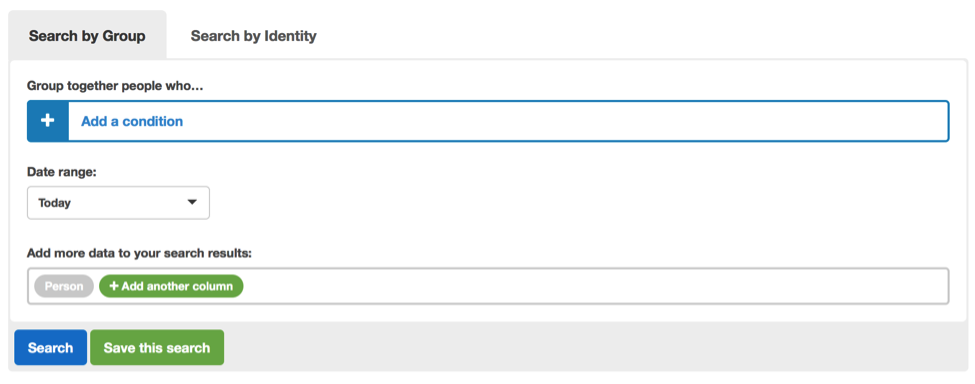
Here’s the setup page for the People Search. We can search by group (i.e., criteria) or by identity (to search for one person in particular). When we search by group, we’ll add our conditions and set our date range. We also have the option to add more data to our search results.
people-search-kissmetrics-basic-setup

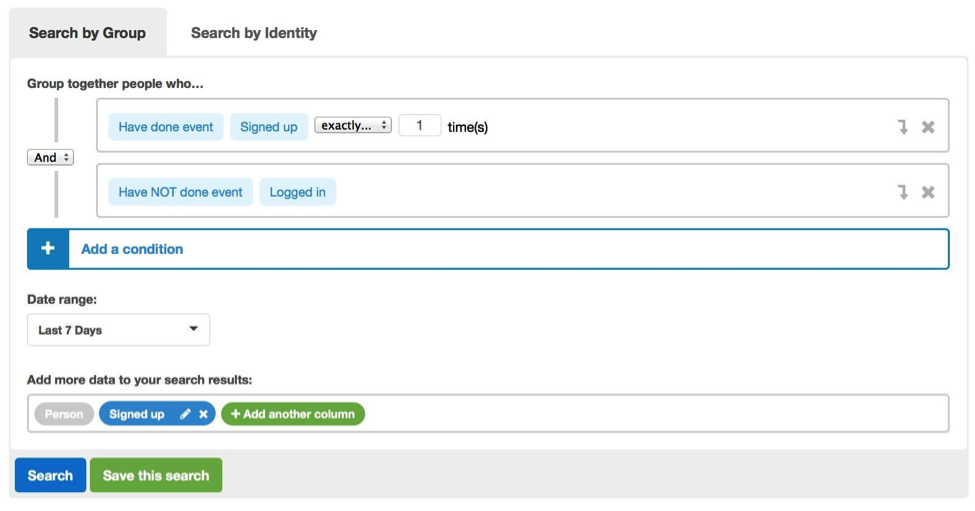
Let’s find the people who signed up and have not logged in. We’ll view people who fit this criteria in the past 7 days, and we’ll be viewing the date they signed up.

Here’s how our criteria looks:

find-unengaged-customers-people-search-kissmetrics

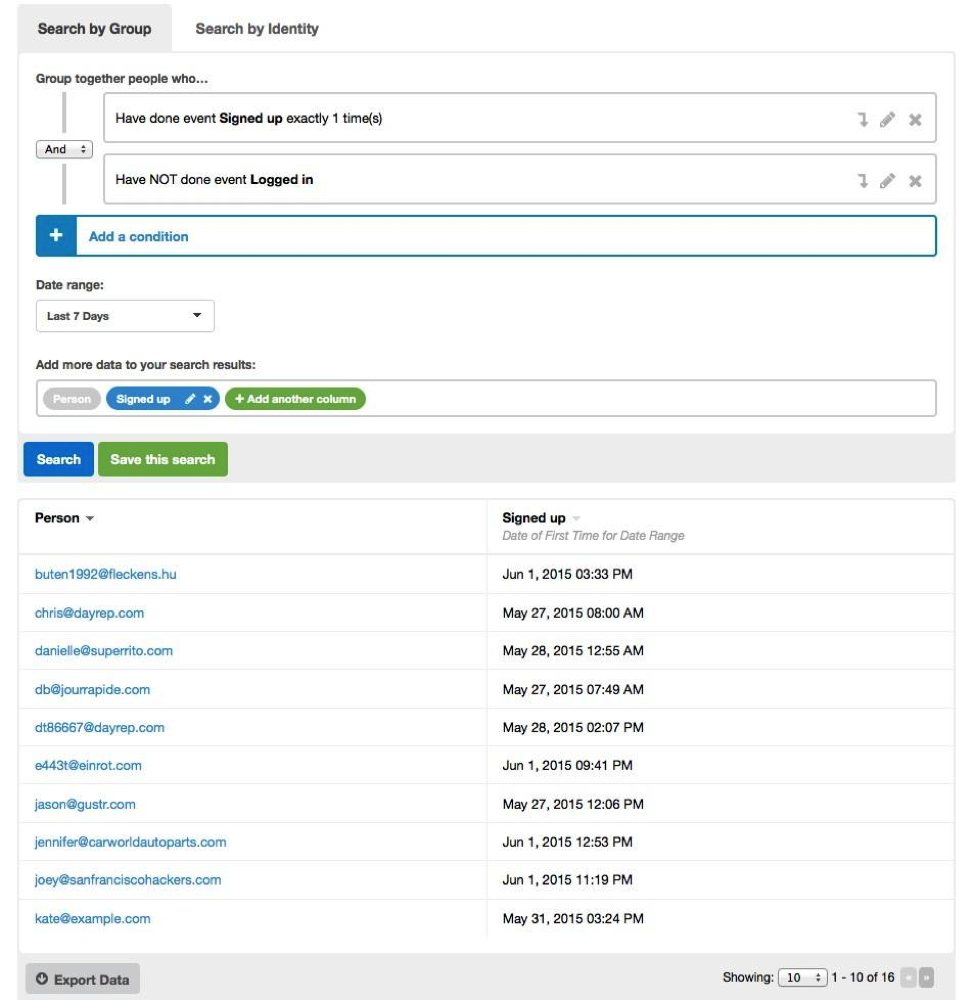
Let’s click Search and see the people who signed up and have not logged in.

people-search-results-signed-up-not-logged-in

And we get our list. No need to bug engineers to run a SQL query. Just set the criteria and get your list in less than 10 seconds.

Since we’re identifying people by email address, there’s no digging to do. We just copy each person’s email address, and then we send them an email in an attempt to get them re-engaged. Here’s a good template to begin with:

From: Your name
Subject: Feedback
Body:
Hi {First name},

I’ve noticed you recently signed up for {name of service}. I appreciate your interest in using our product. However, I’ve noticed that you haven’t logged in yet. I’d love to get your feedback if anything went wrong, if you have any questions, etc. We provide a great product that helps {target market} do {unique value proposition}. I’d love for you to get your hands on it and see how it can {adjective} your {the results it brings people}.

Let me know.

{Your name}
{Job Title}
{Phone}
{Office Address}

We also have the ability to export the email addresses to a CSV file, which can upload into Mailchimp and other email service providers.

Engage the Unengaged

This process is important for building a better business and acquiring more customers. If you do this routinely (i.e., run a People Search for unengaged customers and email them to get feedback), you’ll understand what kinds of people you’re targeting and whether your website is converting the right people. You’ll also get great qualitative feedback that you can filter back into your product development.

Without the People Search, you would have no clue as to who your unengaged customers are, and you would have no way to even begin to get feedback from them.

1 ½ Minute Demo

Want to see a quick demo of the People Search? Just click Play below.

To start using People Search and the suite of KISSmetrics Reports, just sign up for a free 14-day trial. No credit card is required.

Not quite ready to sign up? No worries, just use our Demo site to see how KISSmetrics benefits both SaaS and ecommerce companies.

You can also request a personal demo to see how KISSmetrics works with your business.

About the Author: Zach Bulygo (Twitter) is a Content Writer for KISSmetrics.

Thursday, June 11, 2015

5 Real Estate Landing Page Templates for Your Appraisal

real-estate-landing-page
If showing houses were this easy, no one in real estate would need a landing page. But it ain’t. Image source.

Do a Google search for the name of your city + “real estate.” Click on a few of the sponsored ads. Did you find a landing page?

Chances are you didn’t, because most real estate agents have not yet caught on to the fact that they need to be sending their paid traffic to dedicated landing pages.

If you’re a real estate agent, a broker, realtor or even an agency working on behalf of any of these people, this represents an awesome opportunity for you to stand out from your competition, establish trust and collect a lot more leads.

A few weeks back we held a landing page design competition with our friends over at ThemeForest and got more than 100 submissions in 18 categories. Here are five outstanding real estate landing page templates that anyone can use to give their business that extra edge over the competition.
We’ll break down what’s great about them, and how you can use them to make your marketing more successful.

1. WorkMan

This real estate template comes in two styles: click-through and lead generation.

You can use the click-through template (pictured) for showing off specific properties. Give readers a taste of the houses you’re selling along with a description.

The lead generation template has a form for potential buyers to fill in their information right at the top of the page. This one would be most useful for real estate agents who want to offer prospects a quote or give their visitors information about the service they offer. This information could come in the form of an ebook about how to purchase real estate, a guide to city neighborhoods, or any other content that might be of value to potential homeowners.

Each version of the template has a nice, big space for your hero shot at the top of the page. This is perfect for real estate agents, as it gives you the opportunity to show your prospects some aspirational image that can help them get a better idea of what you’re offering them. As Unbounce’s co-founder Oli Gardner says in his 5 Essential Elements of a Winning Landing Page post:

The idea here is to get your customers to empathize and place themselves in a scenario where they are using it.

In this case, “it” refers to the house you’re selling. On a real estate landing page, that image might be a happy couple in front of a house, a family playing in the backyard, or some folks relaxing on a porch. Whatever you choose, it should help people imagine themselves living in that house.

2. Luxra

luxra-real-estate-unbounce_sm

This page uses conversion centered design, and includes a feature that will be of particular interest to real estate agents — the video section.

Videos increase the length of time people stay on your page, giving your message more time to sink in. And if you feature yourself or company employees in the video, it gives prospects the opportunity to get to know you better. There’s a reason real estate agents put their face on “for sale” signs; people are more likely to buy from people that they know and trust.

Video can be used to address buyer modalities. These are profiles that describe different buyer behaviors.

As CRO extraordinaire (and friend of Unbounce) Angie Schottmuller explains, different buyers require different amounts of information. Video appeals to buyers who need more information and visuals.

If you’re using multiple advertising channels (AdWords, Facebook, Bing, etc), be sure to A/B test a page with video versus one without. This will help you to establish which of those channels is most receptive to video.


Use video to appeal to landing page visitors who want more information!
Click To Tweet


3. Agents

unbounce-real-estate-agent_sm

I love this lead generation page. It reminds me a bit of the benches or billboards that you see with pictures of real estate agents’ bright, smiling faces. Except that this page has a form where folks can immediately send you their information so that you can get in touch with them.

A real estate agent could, for example, offer a free consultation to potential customers on this page.

As a real estate agent, you know the importance of selling yourself to potential clients before you sell a house, and this landing page template offers the opportunity for you to really let your personality shine through.

4. Avira

This is a landing page that would work well for someone selling multiple properties in a new suburban development, for example. From top to bottom, each section gives you the opportunity to show off features of the community that set it apart from others, and the different types of dwellings one might find there.

The map next to the icons that display the amenities in the immediate area is a great touch, as well. It gives your readers a sense of the neighborhood, and may very well generate further interest in the property.  

The other thing this page has going for it is contrast. Notice the use of whitespace, which gives the page plenty of room to breathe. This breaks up the page and draws the eye from one section to the next, allowing you to present your message in nice, bite-sized pieces.


Whitespace on a landing page gives content *and* visitors room to breathe.
Click To Tweet


5. Homes

Now that literally* everyone has a smartphone, landing pages that are mobile responsive are not just a nice thing to have – they’re a necessary part of any marketing campaign. In June of 2014, Google searches from a mobile device totaled 27% of all real estate-related searches. A Google Consumer Study from April 2014 states:

Most people would use their mobile device to do at least one of the following: search for listings, find directions to a house, look for more information on a listing, call or e-mail an agent directly, or watch a video while out looking for a home.

Like the others in this category, this page is mobile responsive. But this page has something that might help readers keep scrolling when they first arrive on their mobile device.

The arrow that points towards the form at the right of the page is a great directional cue that helps draw attention to your form. When designing for mobile, you could take that arrow and point it downward instead. This would give your readers the impetus to keep on scrolling down the page to get all the information they need to convert.

Little touches like this can go a long way towards capturing leads on mobile, so make sure to make the most of them (and test them too)!

*Not literally.

Get what you need to convert

There are more than 170 Unbounce landing page templates on ThemeForest, so if you can’t find what you’re looking for here, make sure to get over there and take a look.

And don’t be afraid to get your hands dirty with some A/B testing. The most important thing you can do when using landing pages for real estate marketing campaigns is to test variations to make sure that you’re reaching your audience in the right way.

You never know what might make the difference between a page that sends you qualified leads, and one that gets ignored.

Be sure to test, test, and then test again!

The Secret of Perfect Workplace Culture

Fresh sushi, made in front of you? Really?

Have you felt the twinge of envy when the rumor goes around about what’s on the menu at Google this week? Have you thought, “If we do that, then we’ll have ‘enviable culture’ too?” Would Nap Pods make all the difference? Have you wondered if culture really is all about perks, or if there’s something more important?

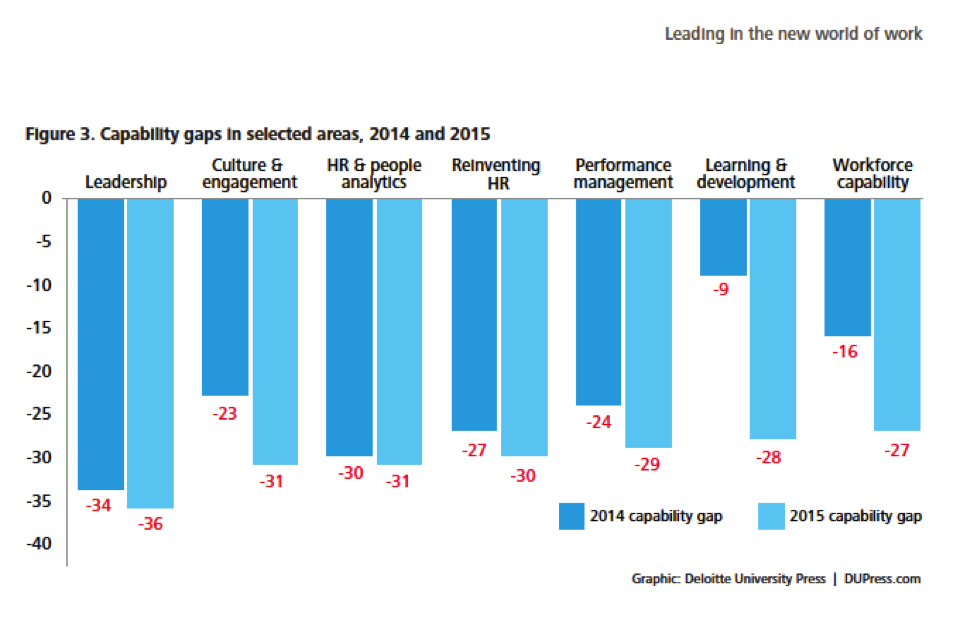
According to Deloitte Global Human and Capital Trends 2015, ‘Culture and Engagement’ is the highest priority on the corporate agenda.

It’s well documented that the strongest cultures attract and keep talented people, with predictable results for the bottom line. Sturdy cultures get stronger, and conflicted ones, weaker. Yet the gap between how important culture is, and how ready we are to make it that way, continues to widen year on year, according to Deloitte.

capability-gaps-in-selected-areas

Source: Human resonance for leaders pap 2015

Why is the culture and engagement capability gap growing?

A piece of foundational philosophy needs to be added – or in some cases, replaced. Philosophically, these statistics suggest that many corporates are becoming unwittingly hamstrung. They’re used to solving things and operating things and measuring things, in terms of ‘I’.

If it worked back in the day (or was more easily hidden behind corporate structure and hierarchy), it doesn’t work now in this age of transparency and connected-ness. This is why culture is now top of the agenda: it’s governed by a different rule.

Culture depends on motive towards other people. Other people matter, and they need to matter more. You don’t just have to show you care. You don’t just have to say you care. You have to want to care, in order to bridge the capability gap.

What destroys our cultural efforts?

Culture is about relationships; it’s what happens between people. It’s not about ‘I’, and it cannot be ‘solved’ with ‘I’ thinking about ‘I’. Yet most of our performance measurements are in terms of ‘I’, or ‘things’.

This is what derails many cultural initiatives. We think we’re about people, but we’re mostly about things – and we don’t like that. In fact, we lie to ourselves about it.

“The world wants to be deceived” – Petronius

We want to be deceived about how much we care. Though we have some interesting tools and metrics that point to this, they are flummoxed by deeper motive, which are difficult to measure. The reason seems obvious:

Motives change the second we attempt to measure them.

Culture is a motive barometer. When people are objectified, culture turns sour.

Objectification devours strong cultures – and it’s catching.

People are not ‘things’ that get in our way. People are not problems to be solved. People are not tools to be used. People are people, each equally important. When we see this, we are wholehearted towards them, and our results reflect that motive. We think in terms of ‘Us’. When people are objects to us, we think in terms of ‘me’, and our actions and results reflect that motive.

No wonder ‘engagement’ is so difficult to pin down. Trusting relationships depend on motive. No wonder leadership is turning inside out; influence depends on motive too. Cultural change requires a fundamental commitment to a philosophy of ‘us’ rather than ‘me’.

Replace Old Myths with Powerful Truths

Out with the old thinking about people. This is the age of transparency and connectedness. Our challenge is to actually care, not just make it look like we do.

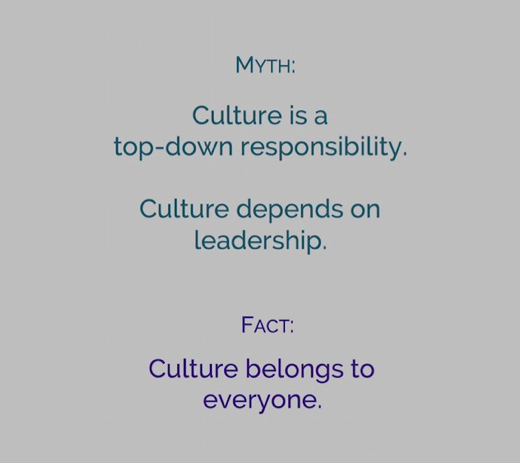
Truth 1: We are all in charge, and we’re all in charge of culture. It’s about time, and it’s good. It’s simple (people are people) but not easy (which is why the capability gap is growing).

culture-is-top-down-myth

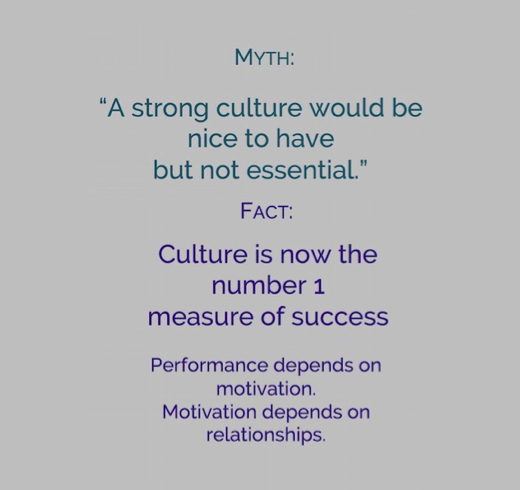
Truth 2: Culture isn’t just important for results – it IS the result. Performance comes after.

Truth 3: Culture doesn’t like being measured (although it is forgiving). Culture does not necessarily comply with ‘cultural goals’ and ‘cultural strategies’, because it is exists between people.

Truth 4: Culture sees through selfish motives (although it tries to retain trust, because people are human, and we humans long to trust).

Truth 5: Culture can’t be faked. Fakery is like a cold draught, causing goodwill to collapse and suspicion to solidify. A sham culture strategy sets one step forward, then several back.

Truth 6: Culture can be helped by ‘good cultural behaviors’, but these are no guarantee. If we think we can control culture with behavioral strategies alone, then we’re likely to discover we’re wrong in various expensive ways.

Truth 7: Culture can’t do half-heartedness, however understandable it is. It needs courageous, wholehearted people.

“What is required is a deed that a person does with their whole being”

– Martin Buber, I and Thou

Truth 8: Corporate failure is different now. Failure is a failure to connect with each other wholeheartedly. Corporate success requires the whole heart; the structures that allowed us to hide have gone. How you are towards people IS the crucial ingredient in the cultural recipe.

Truth 9: Culture is ambushed by the intellectual and the expert.

Being an expert is absolutely no guarantee of genuine connection. I’m an expert at coaching, relationships, influence, but … I can run an enlightened corporate leadership seminar, connecting all day, being marvelous (why not?!) and yet find myself at war with other drivers as I hurtle home.

Advertising ‘the right way’ is a beginning, but it is not the end result – just as reading this post might be motivating, but it’s not the outcome (yet).

Culture needs to be expounded, not advertised. To lean on (a rather overworked) Gandhi, we need to ‘be the change we want to see in the world’.

Truth 10: Culture is easier said than done. Heck, we’re good at knowing what to do. The next bit’s more tricky though, isn’t it? It requires constant personal risk. Vulnerability. The possibility of being changed by someone else.

People who are courageous enough to be open, vulnerable and real, harness people together to perform. Defensive, fearful and divisive cultures turn people inward and against the common good.

Truth 11: Real, strong culture is challenging and tough: There is no room for moaning, whining, false-victimhood. Being true in relationships requires us to stand our ground. Nothing flimsy here. Backbones are stronger than in the old world of ‘I’, because there is no wriggle room.

myth-a-strong-culture-would-be-nice

Can it be done? Yes! Every effort counts. Let’s dive in:

10 Ways to Make Your Culture Magic

You’ve got to admit, it’s great news.

We’re used to being told that we’ve got to learn new stuff, master behavioral programs, brush up on people skills.

But there’s no one magic action that guarantees strong culture. We can pay lip service to good culture – do all the ‘good’ actions – but if we do the right thing for the wrong reason then we do more harm than good.

So what matters is who we are doing it for. Are you in your work for ‘me’ or for ‘us’? Magic is automatically present in anything you do, when you’re in it for us. When other people matter to you as much as you do.

When they do, your purpose is aligned with theirs. Your motive is transparent. That’s what makes or breaks corporate culture.

The 2015 results are in from GreatPlaceToWork.com. Let’s learn about intention and motive from 10 of the latest winners of their Best Workplace Award:

1. Do what you say you’re going to do, with good intent

Follow-through is everything. In strong cultures, “People trust feedback will be confidential and action will be taken to make us a better place to work, says Ryan Cheyne, People Director of Pets at Home. (#15 in the UK)

David Smyth, Director of Swansway Garages, (#21 in the UK) agrees. “Listen to what the feedback tells you, make a plan; then act on it, don’t just talk about it.

2. Be Transparent: Trust and involve people in decisions that affect them

Allow yourself and your decisions to be changed by what other people need. It’s easy to say, but feels like a big risk.

&samhound, the Dutch consulting company (#5 in Europe), hold their top leaders meetings in a ‘fishbowl’ setting, surrounded by most of the companies 100+ employees. Everyone gives their opinion on strategy and other key issues.

Credit Acceptance of Michigan (#37 in the USA) sets transparency standards in the finance sector.

Employees say it has “the best attitude toward employee needs and wants that I have ever seen. The company is very transparent in its dealings. We are given the whole scoop on current and future projects.”

3. Notice modesty, humility and a hard-working heart

People who genuinely care stand out as an inspiration. Become such a cultural ambassador by quietly leading and recognizing others who want good change.

Employees at NetApp, (#1 Multinational in Europe, #35 in the USA), lead their own Guiding Coalition to speak out, lead and provide feedback, going beyond their work responsibilities to reinforce cultural values. Likewise as Chris Oglethorpe from Wragge Lawrence Graham in the UK stresses, “A great workplace doesn’t just happen – it has to be worked at and maintained”.

4. Enable people to be able to solve their own problems by strengthening relationships

Culture takes a dive when we wait for other people to change. It becomes a culture of victimhood. People problems are escalated to management to solve, wasting time and resources and putting pressure on leadership.

Now that structures are more flexible, we must lead the change ourselves through responsibility in our relationships. “Create a culture of ownership and give permission; many issues can be resolved by the teams”, says Fiona Roberts, HR Director at Volkswagen.

5. Be someone others can be themselves with. Be human.

There is no limit to the diversity of us humans, is there?! Yet we still judge, still objectify, and we still have work to do. Knowing that we’re flawed helps culture to be forgiving. Culture accepts that we can only do our best. It’s human. It does not demand perfection.

Theresa McHenry, HR Director at Microsoft, (#5 in Europe) recognizes this need to keep learning from and about each others differences: “We need to continue to focus on creating a diverse experience, rather than a ‘one size fits all’ approach”.

6. Go out of your way to support other teams

It’s easiest to objectify other teams when things go wrong, using them as an excuse for poor performance. Successful teams breed strong cultures by constantly building relationships with all teams.

Other teams need to know – and to feel – that you ‘have their back’ – you’ll help them through problems and mind about them as people.

Unengaged teams quickly escalate problems and trap organizational resources. Tiffany Lath, VP and General Counsel for Rackspace (#6 in the UK), helps teams strengthen relationships: “Our culture contributes to engagement. Teams work collaboratively to ensure it stays alive and well”.

7. Make hierarchy structural only

After centuries of embedding organizational pecking orders, we can be forgiven for wanting to make ourselves and our needs more important than other peoples. Happily, power is shifting, bringing with it a challenge for us all. We all now have a greater capacity to influence. Every person’s influence counts more. And our influence depends on how we see other people. It’s a delicious virtuous circle that lays down a moral gauntlet for everyone. Sharing control felt like a risk in the old world, but in this new connected economy, it’s the safest way to be.

How to do it? Victor Buzachero of Scripps Health has embedded a Horizontal Management Framework to shift Scripps from silo to system-thinking, to make the workplace better for everyone.

“Truly becoming a more democratic workplace is not easy. It requires dedication and a willingness to share power”, says Erik van Reit, Director of Great Place to Work.

8. Be in it for the long haul

Relationships stay alive forever – make them of long-term benefit. Employees are proud of working for a company such as the Danish-born Novo Nordisk, (#11 in Europe) which is “in it for the long haul, not just focusing on the short term.”

9. Stand for yourself, your people and your culture.

Most people won’t, because it’s easier not to be responsible. But there will be people making a quiet, sustained push towards a better workplace. “Our team really values the effort that goes into developing our culture”, says MD of Medela UK, (#4 SME, UK) Paul Furlong.

Finally,

10. Be wholehearted for your people.

It’s you that makes the difference to your culture. People cannot ignore wholeheartedness, because of the courage it takes to keep faith in other people. You’re the person I’m talking to. Don’t give up on your workplace culture.

Never believe that a few caring people can’t change the world. For, indeed, that’s all who ever have. – Margaret Mead, Human Nature and the Power of Culture

Strong cultures are made by people who know their colleagues are the best there are – whoever they are. That’s because genuinely strong people invite strength in other people. Trust and wholeheartedness are the substantial challenge strong people lay down. Accepting this challenge as an equal is what makes you one of the ‘best’ people. You step across the line between weak and strong culture when you are able to give people agency – power and responsibility for their own motives.

The secret to an invincible culture?

The statistics are only stating the obvious.

We’re all human, and we’re in relationships forever, whether we like it or not. It’s just easier to see now. We’ve got the tools to measure, and we’re paying attention in a new way. Corporate performance depends on it.

Our cultures continue to deliver faithfully on motives in relationships.

I or I-Thou, said Martin Buber.

Me or Us.

One way or the other.

About the Author: Rachel Pryor, Leadership, Culture and Conflict Resolution Pro, is the founder of www.MeOrUs.com, Performance Through Relationships. Her workplace relationships app, Us:Work, just launched on iTunes

How To Make A DIY Solar Panel

The economic vitality is essential for both individuals and earth. As a family unit, with the possibility of saving money for electricity bills is an extraordinary method of management. Rather than spend more money in fees, they can put something aside for emergencies. The vitality of the economy can also save the earth. It hurts when power plants one little power is turned on. However the use of less energy can make a huge show on earth homes.

How to make a solar panel?
These are the things that you can easily find at home or near the tool shop, you could make a solar panel to help progress towards the environment and economical. Here progress Making a board of sunshine fed and the things you need:

Sheet metal clippers
Copper flashing piece of ½ feet
Glass vessels or plastic flasks
Tap water
Electronic drill, sand paper
Electronic burner
Alligator clip leads
Micro-ammeter
Safety spectacles
Table salt

Steps to Make:
Use sandpaper to reduce the signs of consumption of copper and completely clean fire. At this point, metal cutting shears so that he would coordinate with the burner.

Put the light on burner and cook for at least 30 minutes to make the copper oxide dark thick enough. When a decent coverage of the copper oxide framed, let cool until chips.

Clean the copper cooled with tap water, however, gradually to the fact that the type of red copper oxide, which has shaped the heating another bright copper away.Cut not the same size as little time recently. Gator with clasps, join the two letters he has done inside the glass container with a wide opening and a plastic container with a higher court. The tips should not touch each other and the curve with the state of the glass or carafe.

Join the crocodile’s head cut extravagant annexed intact on the positive side of the unit. Clasp changed to the plate with the copper oxide must be connected to the negative side. Make an arrangement and salt water. Make a response that can adequately splash motherboards. Fasteners must be between the hammer and the anvil.

Place in the sun and perceive how you can make the leap from the gauge. Then you can use it to help power different machines.

So if you want to organize electricity to effective and affordable then this is the best idea for you, especially when you think about decorating the dining room or formal living room in a professional manner.